Key points
- Researchers made two aluminosilicates, NJU120-5 and NJU120-7, that combine micropores and mesopores in one interconnected 3D network.
- The mesopores are enclosed by walls just two T atoms thick, and those walls contain 10-ring channels.
- Imaging of calcined NJU120-5 showed quasi-rectangular mesopores about 12 angstroms wide and 41 to 162 angstroms long.
- In heavy-oil cracking, both materials gave high yields of valuable fuels and formed less coke.
Chemists have made two porous aluminosilicate materials, named NJU120-5 and NJU120-7, that build the narrow pores of a zeolite and wider channels into a single connected framework. The team reports in Science that both materials performed better in heavy-oil cracking, turning out high yields of valuable fuels while producing less coke, the carbon buildup that fouls catalysts.
Zeolites are crystalline minerals full of pores narrower than a nanometer. Those pores let them sort molecules by size and shape, but the tight passages also slow the movement of molecules in and out. Materials whose structure already includes larger pores, called mesopores, can speed up that traffic and still keep the selectivity. According to the researchers, though, such materials remain difficult to make.
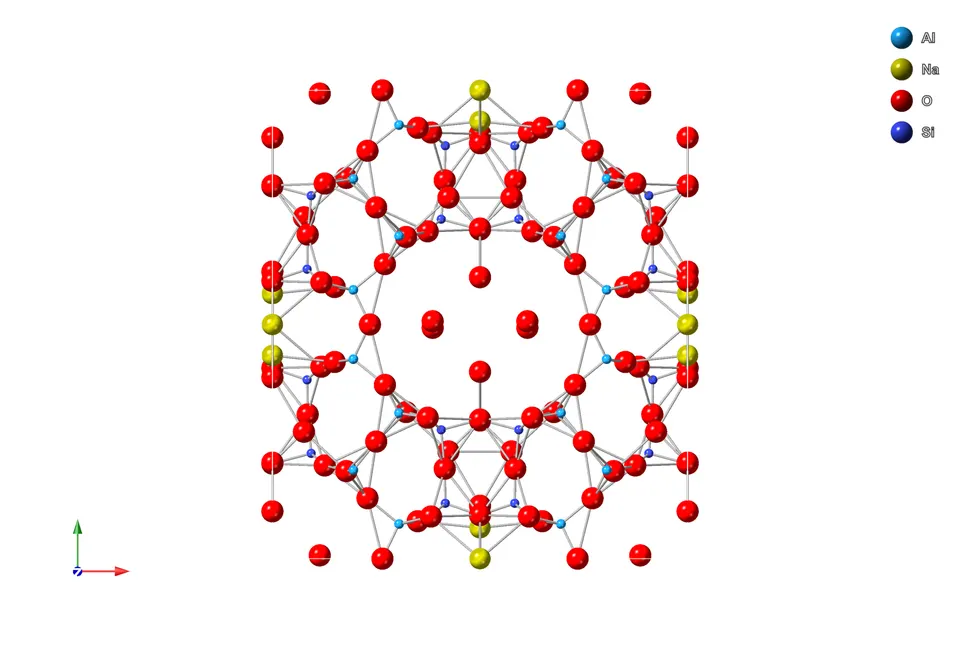
In the new materials, each mesopore is enclosed by a wall only two T atoms thick. T atoms are the silicon or aluminum atoms at the center of the framework's building blocks. The walls themselves are threaded with 10-ring channels, so the whole pore system connects in three dimensions. The team used advanced electron ptychographic imaging to build plausible models of the frameworks. In calcined NJU120-5, typical mesopores looked roughly rectangular, with a uniform width of ~12 angstroms and lengths between 41 and 162 angstroms.
Both materials are highly porous and show strong Brønsted acidity, a property that helps them drive reactions. The authors call their framework structures plausible models, not final structural solutions.
Why it matters
Zeolites are valued for size and shape selectivity, but their tiny pores limit diffusion. Materials that keep the selectivity while speeding molecular transport could make processes such as heavy-oil cracking produce more fuel and less coke.
What we don't know yet
The framework structures are described as plausible models based on imaging, not fully confirmed structures. The performance results come from heavy-oil cracking tests reported in the study.
Terms in this story
- Zeolite
- A crystalline aluminosilicate mineral riddled with molecule-sized pores, widely used as a catalyst and molecular sieve.
- Mesopore
- A pore larger than a zeolite's subnanometer micropores, which gives molecules a wider pathway through the material.
- Brønsted acidity
- The ability of a material to donate protons, which lets it drive many chemical reactions.
Sources and verification
DexScience articles are produced with AI assistance and an automated fact-check against the linked sources. Spotted an error? Tell us and we will correct it openly.