Key points
- Long pentoxy side chains line the pore openings of C5-IRMOF, forming a gate that responds to heat.
- Trapped guests escape suddenly at an unusually high temperature, even though the framework has no strong binding sites.
- The release peak shifted almost one-for-one with the temperature at which the material was first exposed.
- The confined pores enabled kinetic quantum sieving of hydrogen isotopes at temperatures up to 100 K.
Researchers have made a porous crystal whose pore openings stay shut until they are warmed. In this material, the temperature at which a guest molecule is loaded decides how hot the material must get before that guest comes back out. The material is a metal–organic framework called C5-IRMOF, and its tight pores can also separate hydrogen isotopes at temperatures up to 100 K, the team reports in a peer-reviewed Wiley-VCH journal.
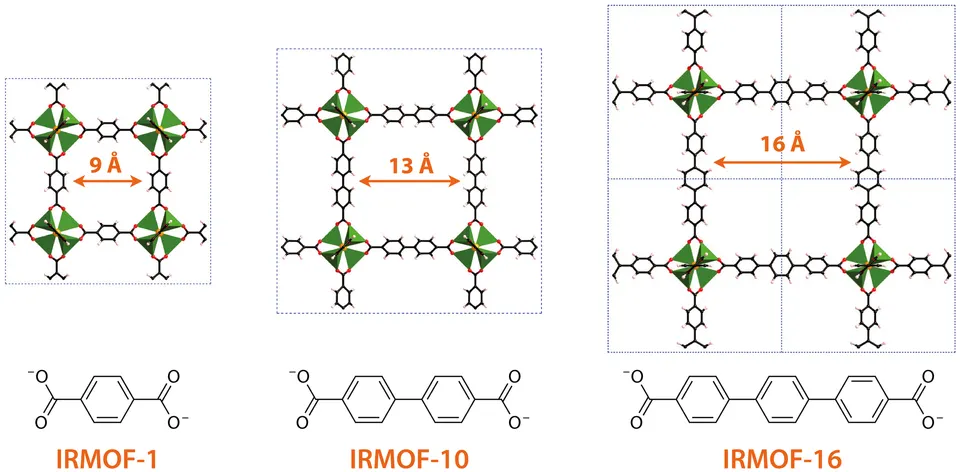
Metal–organic frameworks are crystals of metal clusters joined by organic linkers, and they are full of tiny pores. In most porous solids, the moment a trapped guest leaves depends on how tightly it binds inside and on how the sample is heated. That leaves chemists little control over the release temperature. In C5-IRMOF, long pentoxy side chains crowd around each pore opening. They form a narrow, heat-sensitive gate in front of a large internal cavity.
The gate works as a kinetic valve. Guests stay locked inside until heat makes the chains move enough to reopen the passage. The guests then escape all at once at an unusually high temperature, even though the framework has no strong binding sites. A sister material with shorter butoxy chains, C4-IRMOF, behaved like an ordinary microporous adsorbent instead. Using cryogenic thermal desorption spectroscopy, the team found that the release peak tracked the original exposure temperature almost one-for-one.
The researchers say the same tight confinement allowed kinetic quantum sieving of hydrogen isotopes up to 100 K. They describe flexible side chains as an easy lever for designing porous materials that release their contents at a chosen temperature.
Why it matters
The researchers present this temperature-programmed release as a new kind of pore function. Flexible side chains could give chemists a simple way to set when porous materials release trapped guests.
What we don't know yet
The sources report isotope sieving only at temperatures up to 100 K. They give no data on separation performance or practical use beyond these laboratory measurements.
Terms in this story
- Metal–organic framework (MOF)
- A crystalline material built from metal clusters linked by organic molecules, filled with tiny, regular pores.
- Kinetic quantum sieving
- A way of separating very light molecules, such as hydrogen isotopes, by exploiting quantum effects that make them pass through narrow pores at different rates.
- Thermal desorption spectroscopy
- A technique that heats a sample and records the temperatures at which adsorbed molecules are released.
Sources and verification
DexScience articles are produced with AI assistance and an automated fact-check against the linked sources. Spotted an error? Tell us and we will correct it openly.