Key points
- Inverted perovskite cells reached a certified power-conversion efficiency of 27.96% and a stabilized output of 27.84%.
- The devices kept over 95% of their initial efficiency after 2000 hours of continuous operation under 1-sun light.
- Perovskite–silicon tandem cells made with the same strategy reached a certified stabilized output of 34.71%.
- The study appears in Nature; its corresponding authors include researchers at Xi'an Jiaotong University, EPFL and the National University of Singapore.
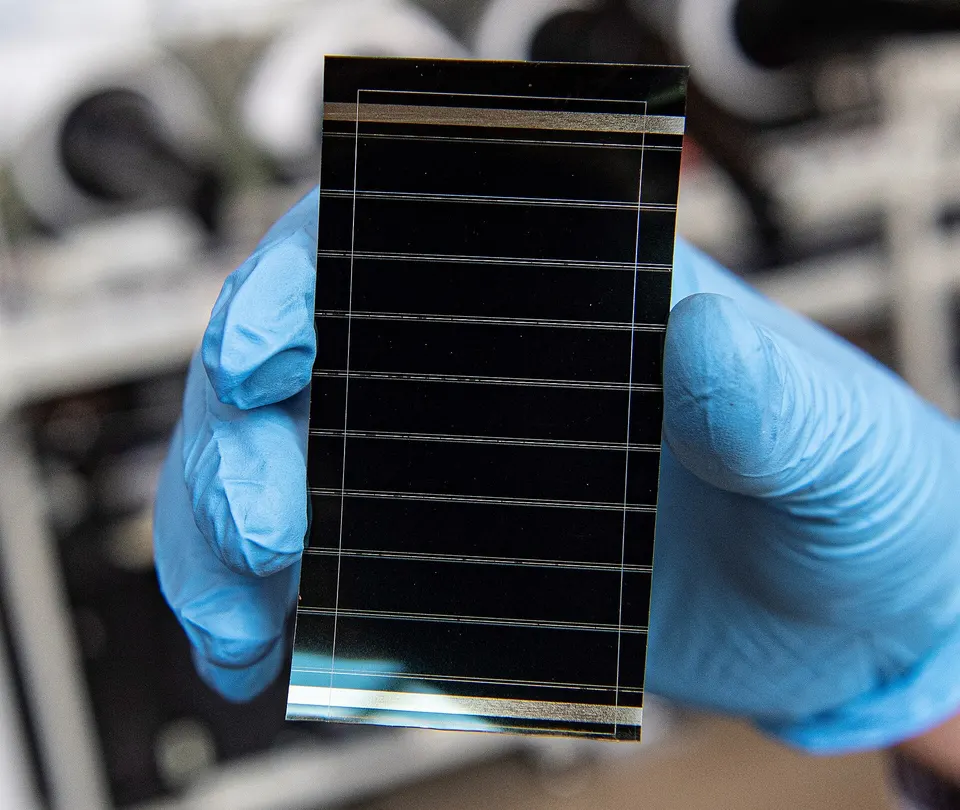
Researchers in China, Switzerland and Singapore have changed how a perovskite solar cell's light-absorbing layer connects to the layer that carries electrons away. Their inverted perovskite cells reached a certified power-conversion efficiency of 27.96%. In a paper in Nature, a team whose corresponding authors include Yuhang Liu of Xi'an Jiaotong University and Michael Grätzel of EPFL reports that the same approach gave perovskite–silicon tandem cells a certified stabilized output of 34.71%.
Perovskites are crystalline materials that absorb sunlight very well, and the authors note that their efficiency is now close to that of mature silicon cells. To go further, cells have to lose less energy at the boundary with the electron-transport layer. At that boundary, electrons can get stuck or recombine, which means they are lost before they can be collected as current. Surface treatments called interfacial modifiers are widely used to reduce these losses. According to the researchers, many conventional ammonium-based modifiers link only weakly to the perovskite electronically and can block electrons from passing through.
The team instead used a family of fully conjugated formamidinium molecules that contain heteroatoms. Conjugated molecules have alternating chemical bonds that let electrons spread across the whole molecule. The researchers say this creates delocalized pathways for electrons across the boundary and cuts down on energy-wasting recombination, an effect they describe as extending the band edge.
The cells also lasted. They kept more than 95% of their starting efficiency after 2000 hours of continuous operation under 1-sun illumination. During that test, which followed a protocol called ISOS-L, the cells were held at their maximum power point, the operating setting that delivers the most power. Their stabilized power output was 27.84%, close to the certified efficiency.
The tandem devices are monolithic, meaning the perovskite and silicon cells are built as a single stacked unit. The authors suggest band-edge extension could apply widely, because it eases the usual tradeoff between protecting a surface and pulling charge out through it. Supplementary material with the paper covers temperature-dependent operational stability and tests of the coupling mechanism in 1.68 eV perovskites.
Five researchers, Bitao Dong, Meijie Cui, Cong Chen, Ruoting Zhao and Huanxin Ju, contributed equally to the work. The six corresponding authors are based at Xi'an Jiaotong University, EPFL, Fudan University and the Shanghai Synchrotron Radiation Facility, Northwestern Polytechnical University, the National University of Singapore and the CNPC Tubular Goods Research Institute. Nature has released the paper as an early accepted version, and it may still be edited.
Why it matters
The authors present band-edge extension as a general approach that avoids the usual tradeoff between protecting the perovskite surface and getting charge out of it. That could matter for both single-junction perovskite cells and perovskite–silicon tandems.
What we don't know yet
Nature released the paper as an early accepted version that may still be edited before the final version of record. The reported stability results cover 2000 hours of testing under the ISOS-L protocol.
Terms in this story
- Perovskite
- A family of crystalline materials with a particular atomic arrangement that absorb sunlight strongly and can be made into thin solar cells.
- Tandem solar cell
- A device that stacks two light absorbers, here perovskite on silicon, so that each one captures a different part of the solar spectrum.
- Non-radiative recombination
- A process in which an electron recombines with a positive charge and gives off its energy as heat instead of producing usable current.
Sources and verification
DexScience articles are produced with AI assistance and an automated fact-check against the linked sources. Spotted an error? Tell us and we will correct it openly.