Key points
- Six general-purpose machine-learned force fields were compared with the classical GAFF2 model against quantum-mechanical reference calculations.
- The QVib benchmark covers 293 molecules and 1366 conformers built from 7 elements.
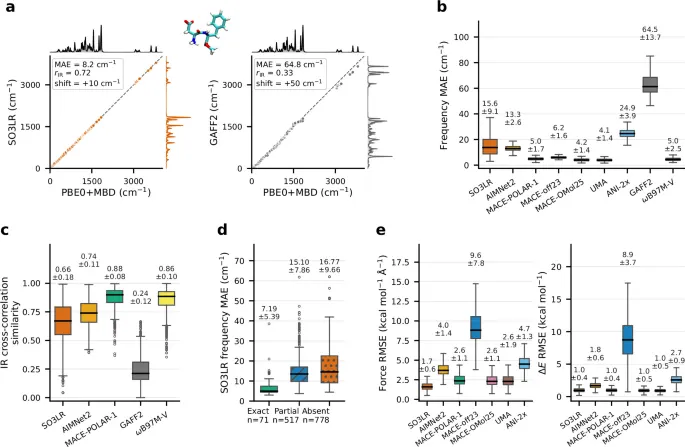
- For aspartame, SO3LR's mean frequency error was 8.2 cm−1, compared with 64.8 cm−1 for GAFF2.
- The team extended the analysis to alanine-based peptides and to the p53 oligomerization domain.
Simulations that use force fields trained on quantum-mechanical data can match the way molecules vibrate much more closely than a standard classical model, researchers report in Nature Communications. They also carried the comparison from small molecules up to peptides and a protein domain.
Molecular dynamics simulations normally rely on empirical force fields. These are sets of rules that estimate how atoms push and pull on each other. According to the authors, such models ignore quantum effects like polarization and charge transfer. Machine-learned force fields (MLFFs) are trained only on quantum-calculated forces and energies. They also account for atomic interactions out to roughly 15 Å, while classical models cover non-Coulomb pair interactions only to 8–10 Å.
The team tested six MLFFs, among them SO3LR, AIMNet2 and MACE-POLAR-1, alongside the classical GAFF2 model. They checked every model against density functional theory, a quantum-chemistry method, on a benchmark they call QVib. It contains 1366 conformers, or distinct 3D shapes, drawn from 293 molecules. Some are simple and others are drug-like, such as ibuprofen and haloperidol. For aspartame, SO3LR's mean frequency error was 8.2 cm−1. GAFF2's was 64.8 cm−1. SO3LR also captured how individual vibrations show up in infrared spectra.
The researchers then examined alanine-based peptides and the p53 oligomerization domain, both as a single unit and as a four-unit assembly, in vacuum and in water. As far as they know, SO3LR is the only general-purpose MLFF fast enough for simulations of this size that still handles long-range interactions explicitly.
Why it matters
The authors say their results move simulations closer to being fully predictive. That could eventually include intrinsically disordered proteins and antibodies that contain non-natural amino acids.
What we don't know yet
Much of the benchmarking uses a harmonic approximation, which leaves out anharmonic couplings and large-amplitude motions. The authors also leave interactions over even longer distances, which current MLFFs cannot describe, to future work.
Terms in this story
- Force field
- A set of mathematical rules that estimates the forces between atoms so a computer can simulate how molecules move.
- Density functional theory
- A widely used quantum-mechanical method for calculating the electronic structure and energy of molecules.
- Conformer
- One of the different 3D shapes a molecule can take by rotating around its chemical bonds.
Sources and verification
DexScience articles are produced with AI assistance and an automated fact-check against the linked sources. Spotted an error? Tell us and we will correct it openly.