Key points
- Cobalt hydroxide nanoplates thickened, and cobalt dissolved from them and redeposited on the carbon electrode during oxygen evolution.
- Without iron, the plates' bases spread 20–30 nm sideways, and cobalt deposits formed an almost continuous film.
- With iron in the electrolyte, surface restructuring and cobalt redeposition were both reduced.
- In a survey of more than 40 reacted plates, those cycled with iron kept more of their original shape.
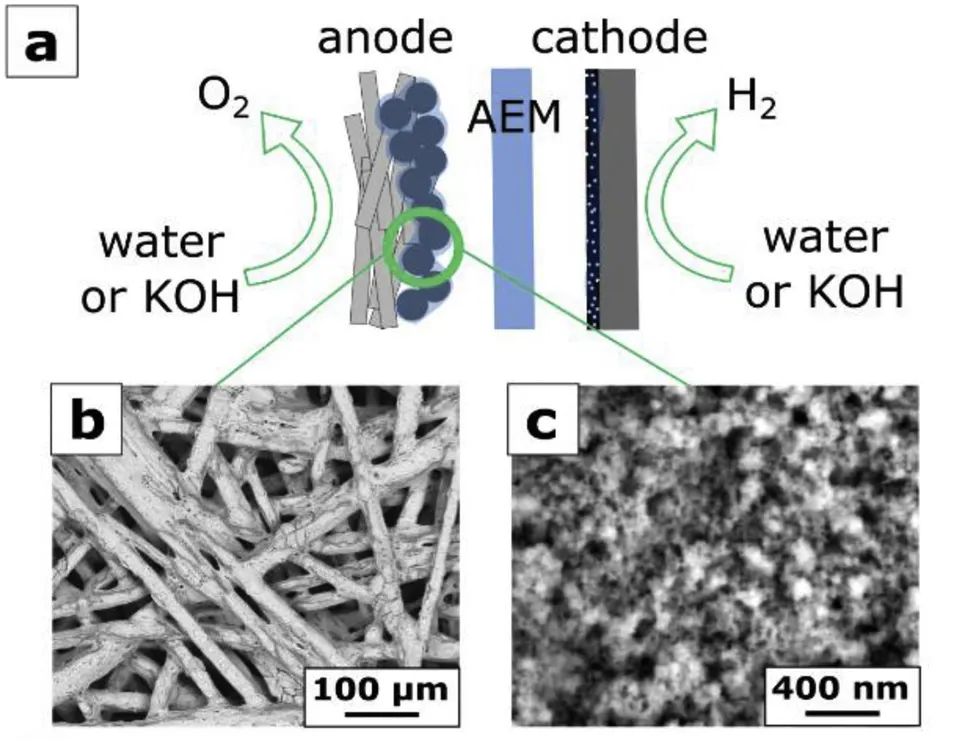
Researchers have filmed cobalt hydroxide nanoplates changing shape while they produce oxygen from water. The nanoplates are a commonly studied starting material for water-splitting catalysts. Reporting in Nature Catalysis, the team shows that cobalt leaves the plates and settles on the surrounding carbon electrode. When iron was present in the liquid electrolyte, both the reshaping and this redeposition were reduced.
The oxygen-producing half of water splitting, called the oxygen evolution reaction, is widely considered the bottleneck of the process. Catalysts based on transition metals are cheap and abundant, but they tend to lose stability as their structure shifts during use. Iron impurities are known to boost the activity of nickel- and cobalt-based materials, but scientists still debate why.
To find out, the team imaged hexagonal plates 80 to 150 nm wide inside working electrochemical cells, using both electron microscopy and atomic force microscopy. They ran the reaction in a mildly alkaline borate buffer (pH ~9.8). The material is less stable under those conditions, so the changes happened faster. The plates thickened in both electrolytes. In iron-free electrolyte, their bases also spread 20–30 nm sideways into a truncated-pyramid shape, and cobalt deposits built up into an almost continuous film.
In separate benchtop tests in iron-free electrolyte, dissolved cobalt rose to a peak of ~74 ppb at 1.7 V RHE and fell again as the voltage was lowered, indicating that cobalt dissolves at high potentials. Control runs on bare electrodes produced no cobalt or iron deposits, which ruled out impurities in the electrolyte as the main source of the cobalt. Across more than 40 reacted plates, those cycled with iron were less covered by redeposited material and kept more of their original shape.
Why it matters
The researchers say that understanding how catalyst surfaces restructure, and how that changes their active sites, is key to designing better catalysts for water splitting. Tracking the plates directly bears on the open question of how iron improves cobalt-based catalysts.
What we don't know yet
The experiments used mildly alkaline conditions chosen on purpose to speed up the catalyst's changes. Trace cobalt in the iron salt also made dissolution in the iron-containing electrolyte hard to track with mass spectrometry.
Terms in this story
- Oxygen evolution reaction
- The electrochemical step in water splitting that releases oxygen gas, involving the transfer of four electrons.
- Operando microscopy
- Imaging a material while it is actively working, rather than before or after the reaction.
- Redeposition
- The process by which atoms dissolved from a material settle back onto a nearby surface.
Sources and verification
DexScience articles are produced with AI assistance and an automated fact-check against the linked sources. Spotted an error? Tell us and we will correct it openly.