Key points
- A genome scan of roughly 79,000 European-ancestry people found 63 independent variants tied to lean mass.
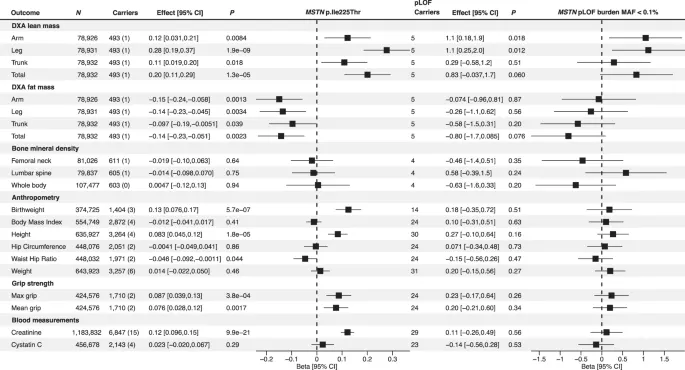
- The rare MSTN variant p.Ile225Thr had the largest effect, strongest for leg lean mass.
- Carriers had more myostatin circulating overall but a smaller share in its active form, fitting a loss of function.
- The authors flag suggestive links to heart failure, so cardiovascular safety needs study for myostatin-blocking drugs.
A rare change in the gene for myostatin, a protein that restrains muscle growth, is linked to greater lean body mass in people, researchers report in Nature Communications. The team compared the genomes of about 79,000 people of European ancestry from Iceland and the UK Biobank with their lean mass. Lean mass was measured with whole-body X-ray scans known as DXA and adjusted for sex, age, height and body mass index.
The search turned up 63 independent variants tied to lean mass. A rare variant in the MSTN gene, called p.Ile225Thr, had the largest effect of any of them, and its link was strongest with leg lean mass. It is a missense variant, meaning it swaps one building block of the protein for another. Carriers had more myostatin circulating overall, but a smaller share of it was in its active form. The authors say this pattern fits a loss of the protein's function. The variant was also associated with greater strength, more growth in the womb and a lower risk of primary hypertension. It was most common in Finnish and Norwegian populations, at 1.03% and 0.95% respectively.
A common variant near ACVR2B, the gene for the receptor that myostatin acts through, was tied to lower lean mass and lower circulating myostatin. According to the researchers, the results suggest that both the signaling protein and its receptor help set muscle mass in humans.
The authors say the findings offer clues about what blocking myostatin over the long term might do. Partial blocking may be beneficial, they note, but suggestive links to non-ischemic heart failure and dilated cardiomyopathy mean any such therapy should be checked for heart safety.
Why it matters
Keeping muscle matters more as populations age and as weight-loss therapies become more widely used. Human genetic evidence like this can help guide the search for muscle-preserving drugs.
What we don't know yet
The strongest evidence comes from people of European ancestry, where the variant is mostly found. Adjusting for body size could introduce bias, which the authors say should be checked for each locus. Suggestive heart-related associations call for cardiovascular safety testing of any therapy.
Terms in this story
- Myostatin
- A protein made mainly in skeletal muscle that limits how much muscle grows.
- Lean mass
- Body weight that is not fat, including muscle, organs and other tissue.
- DXA
- A low-dose X-ray scan that measures how much fat, lean tissue and bone the body contains.
Sources and verification
DexScience articles are produced with AI assistance and an automated fact-check against the linked sources. Spotted an error? Tell us and we will correct it openly.