Key points
- In Drosophila, Rhodopsin 7 (RH7) is found widely in the brain and optic lobe rather than serving image-forming vision.
- RH7 detects changes in brightness over time and guides fast behavioral responses, the researchers report in eLife.
- Flies lacking RH7 were less active in the dark phase; strains with RH7 permanently switched on were more active.
- Evolutionary comparisons suggest RH7 is an old rhodopsin present across panarthropods.
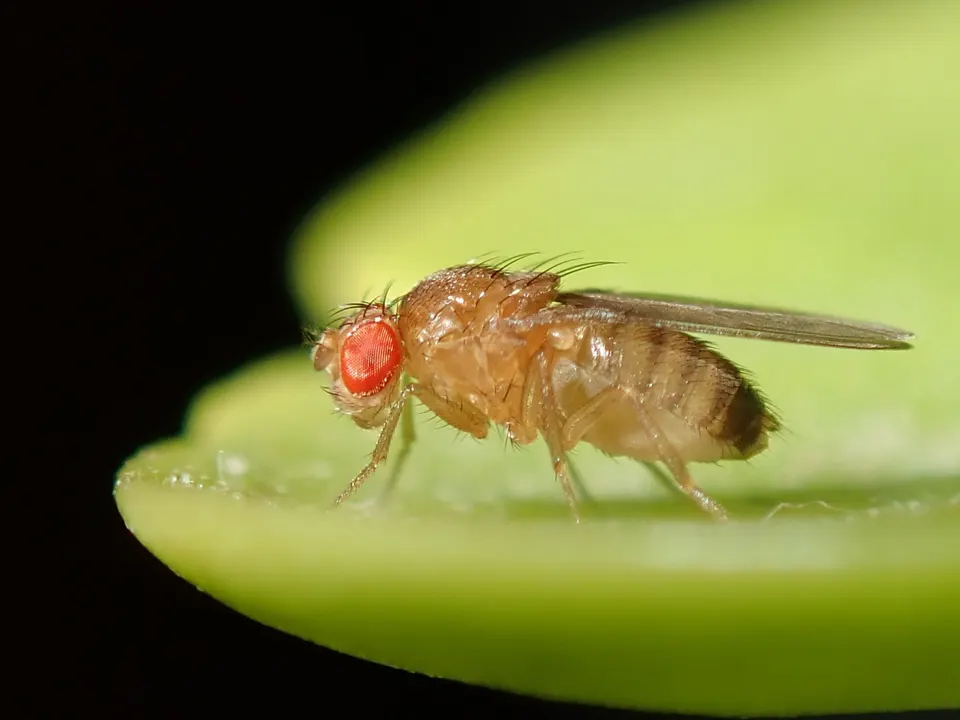
A light-sensing protein in the fruit fly brain does not help the insect see. Instead, it helps the fly notice when light levels shift, according to a study published in the journal eLife. The researchers report that the protein, Rhodopsin 7 (RH7), tracks changes in brightness over time. It steers quick behavioral reactions and helps set the fly's daily pattern of activity.
Rhodopsins are light-absorbing proteins, and in Drosophila most of them are used to form the visual image. RH7 is an exception. It turns up broadly across the brain and the optic lobe, and the team compares it to melanopsin, a mammalian light sensor that works outside image-forming vision. To work out what RH7 does, the researchers mapped where it is made, ran behavioral experiments and compared it with related proteins in other animals.
The fly experiments pointed to a role in activity. Flies without RH7 moved around less during the dark part of the day. Fly strains whose RH7 is locked in an always-on state were more active.
The evolutionary comparisons suggest RH7 is an old rhodopsin found throughout panarthropods, the broad animal group that includes insects and other arthropods. The authors propose that it sits between general G protein–coupled receptors and specialized rhodopsins. If so, it would mark a key step in how animals came to sense light without vision.
Why it matters
The researchers say RH7 acts as a melanopsin-like sensor that shapes fly behavior. They argue it also offers clues to how light detection first arose.
What we don't know yet
The behavioral findings come from fruit flies. The claim that RH7 is an evolutionary intermediate rests on phylogenetic analyses that the authors describe as suggestive.
Terms in this story
- Rhodopsin
- A light-absorbing protein that lets cells detect light.
- Melanopsin
- A light-sensing protein in mammals that responds to light without contributing to forming images.
- G protein–coupled receptor
- A large family of proteins on cell surfaces that detect signals and relay them into the cell.
Sources and verification
DexScience articles are produced with AI assistance and an automated fact-check against the linked sources. Spotted an error? Tell us and we will correct it openly.