Key points
- Voyager 1 crossed one light-day from Earth, roughly 16.1 billion miles, or 25.9 billion kilometers, at 2:16 a.m. PST on Nov. 18.
- The team has received no science or engineering data since Nov. 14; engineers confirmed the milestone via carrier signal and trajectory calculations.
- Radio signals now take 24 hours to travel each way between Earth and the spacecraft.
- NASA expects recent power-saving steps to keep both Voyagers' current science instruments working through at least the 50th anniversary of their launches.
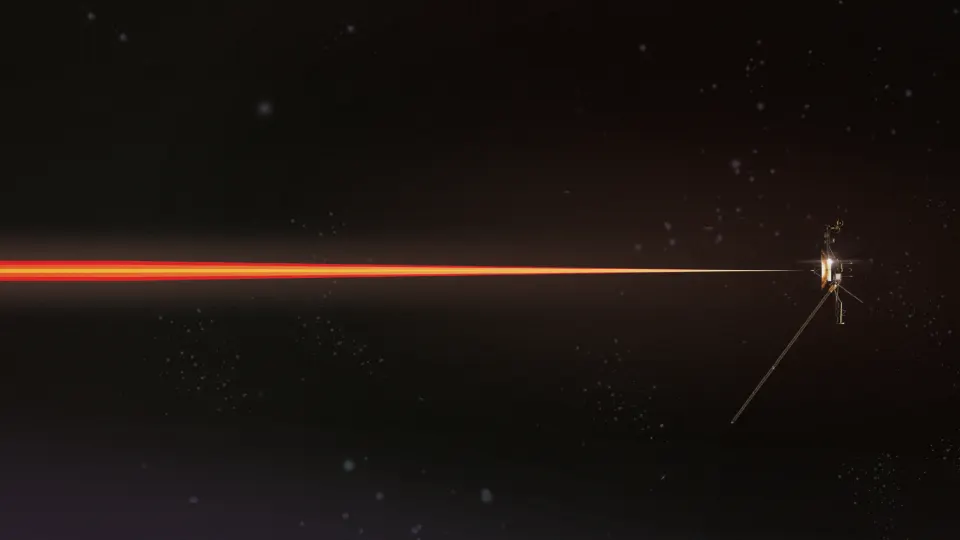
NASA's Voyager 1, which the agency calls humanity's farthest-flying spacecraft, is now one light-day from Earth. That is the distance light covers in 24 hours, roughly 16.1 billion miles, or 25.9 billion kilometers. According to NASA, the probe passed the mark at 2:16 a.m. PST on Nov. 18 (5:16 a.m. EST), having been under way for more than 49 years.
Some numbers help show the scale. In a vacuum, light moves roughly 186,000 miles, or 299,000 kilometers, every second. A beam of sunlight passing Earth reaches the Moon in roughly 1.3 seconds and Neptune in about four hours. It then needs another 20 hours to catch up with Voyager 1. A light-year, for comparison, covers 5.88 trillion miles, or 9.46 trillion kilometers.
The milestone came while the team was dealing with a problem. Since Nov. 14, the team at NASA's Jet Propulsion Laboratory (JPL) in Southern California, which Caltech manages, has received no science or engineering data from the probe. Voyager 1 is still sending its carrier signal, the radio wave that normally carries that data home. Engineers used that signal, along with trajectory calculations, to confirm the crossing. They heard from the probe early Thursday, 24 hours after the milestone, because that is how long its signal took to reach Earth. They are still analyzing the issue affecting the data.
The two Voyagers lifted off in 1977, timed to exploit an uncommon lineup of the planets. They became the third and fourth spacecraft ever to visit Jupiter and Saturn, and they were the first to send back high-resolution images of those planets and their moons. Later, Voyager 2 continued on to Uranus and Neptune. In 2012, Voyager 1 became the first spacecraft to leave the heliosphere, the Sun's bubble of particles and magnetic fields that deflects cosmic radiation. At the time it was moving at about 38,000 mph (61,155 kph). Voyager 2 followed on a different path in 2018.
NASA says the pair are humanity's only probes in interstellar space, and both still track changes in the Sun's magnetic field. Linda Spilker, Voyager project scientist at JPL, says one big surprise has been how far the Sun's influence reaches, all the way out to Voyager 1. Nobody yet knows where that influence finally gives way to untouched interstellar space. She says Voyager may last long enough to find out.
Keeping the probes alive has taken inventive engineering. The team has worked around clogged thrusters and a malfunctioning computer. Each spacecraft runs on a radioisotope thermal generator, which works like a nuclear battery by turning the heat of decaying plutonium into electricity. As the plutonium runs down, each probe loses about 4 watts of power a year. Earlier this year, engineers took a risk and replaced three devices on Voyager 1 with three lower-power alternatives.
NASA's Deep Space Network, large antennas at three sites around the world, handles all contact with the probes. Suzanne Dodd, Voyager project manager at JPL, says the team listens to Voyager 1 every day and sends commands once a week. Each probe also carries a Golden Record, a gold-plated copper phonograph record of images and sounds from Earth. Dodd says that once Voyager 1 can no longer talk to Earth, it will carry on as a silent envoy to the stars.
Why it matters
The light-day mark shows how far the mission has gone. NASA says both Voyagers continue to measure changes in the Sun's magnetic field and are helping scientists learn how far the Sun's influence reaches, although the team has not received Voyager 1's science data since Nov. 14.
What we don't know yet
The team has not received science or engineering data from Voyager 1 since Nov. 14, and engineers are still analyzing the issue. Each probe's power keeps falling by about 4 watts a year. NASA expects the current instruments to keep working through at least the 50th anniversary of the launches, which comes next summer.
Terms in this story
- Light-day
- The distance light travels in 24 hours, roughly 16.1 billion miles, or 25.9 billion kilometers.
- Heliosphere
- The region of particles and magnetic fields blown outward by the Sun, which deflects cosmic radiation.
- Radioisotope thermal generator
- A power source that works like a nuclear battery, turning the heat of decaying plutonium into electricity.
Sources and verification
- NASA’s Voyager 1 Makes History Reaching One Light-Day From Earth - NASA
- NASA’s Voyager 1 Makes History Reaching One Light-Day from Earth
DexScience articles are produced with AI assistance and an automated fact-check against the linked sources. Spotted an error? Tell us and we will correct it openly.