Key points
- New Atacama Compact Array (ACA) data from 2019 and 2023 are more than twice as sensitive as the 2017 observations.
- A 2017 study had proposed a cold outer debris disk about 30 au from Proxima Centauri.
- The features attributed to that disk did not shift with the star's motion across the sky.
- The team concludes an outer disk is unlikely and the features are probably background sources.
Proxima Centauri, the nearest star to the Sun, probably has no cold dust belt circling it after all. A team revisiting the star with deeper observations from the Atacama Large Millimeter/submillimeter Array (ALMA) reports in The Astrophysical Journal Letters that an outer debris disk is unlikely. Debris disks are rings of dust left over from planet formation.
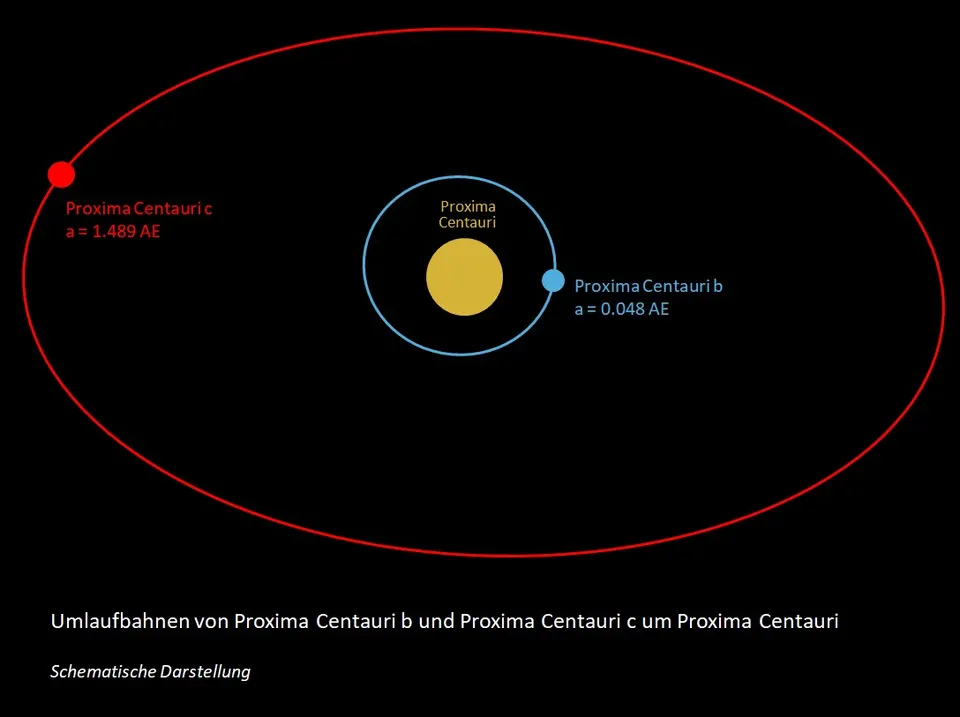
In 2017, G. Anglada and colleagues reported three possible dust structures around the star, including a faint, very cold outer belt about 30 au out that might hold about 0.33 Earth masses of material. Had all three been real, Proxima's system would have looked much like ours, with terrestrial planets plus enlarged counterparts of zodiacal dust, the asteroid belt and the Kuiper Belt. In 2018, M. A. MacGregor and colleagues showed that a huge flare, which boosted the star's millimeter brightness nearly 1000 times in about a minute, could explain the extra light first attributed to an inner belt.
The new study used Atacama Compact Array data from 2019 and 2023 that are more than twice as sensitive as the 2017 data, together with higher-resolution 12 m array observations from 2021. Proxima moves quickly across the sky, so dust bound to the star should move along with it. The researchers found that the patches once read as the eastern side of the disk stayed fixed instead, so they are likely background objects.
The star still hosts Proxima b, a planet at least roughly Earth's mass orbiting in the star's theoretical habitable zone, the region where a planet could be about as warm as Earth.
Why it matters
The 2017 claims had painted Proxima's system as strikingly similar to our own. Earlier work showed stellar flares could account for the inner dust signals, and the new data suggest the last remaining candidate, the outer belt, was probably background sources.
What we don't know yet
The authors say faint signal in the Atacama Compact Array data prevented a calibration step, so some position offsets between observing years likely remain. Dust in a system can also be too faint to detect.
Terms in this story
- debris disk
- A ring of dust and rubble around a star, produced as leftover building blocks of planets collide and grind each other down.
- proper motion
- The gradual change in a star's position on the sky caused by its movement relative to the Sun.
- au
- The astronomical unit, the average distance between Earth and the Sun.
Sources and verification
DexScience articles are produced with AI assistance and an automated fact-check against the linked sources. Spotted an error? Tell us and we will correct it openly.