Key points
- A silicon nitride chip cut a parametric oscillator's intrinsic linewidth roughly 15-fold relative to its pump laser, down to 10 Hz.
- Using an erbium-doped waveguide amplifier as the external cavity lowered the intrinsic linewidth further, to about 0.6 Hz.
- Before this work, the feedback approach had been shown only with a fiber delay line.
- Simulations suggest that with lossless feedback, the signal linewidth could fall below the Schawlow-Townes linewidth of the oscillator without feedback.
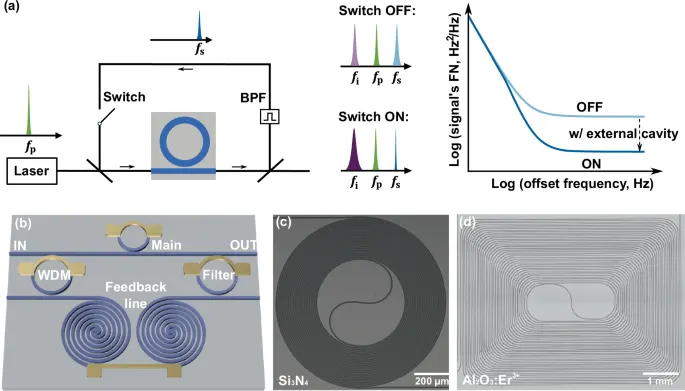
A team working on a silicon nitride chip has made a light source whose intrinsic linewidth, the researchers say, puts it on par with self-injection-locked semiconductor lasers. In Nature Communications, they report that feeding one output of an optical parametric oscillator back into the device narrowed its intrinsic linewidth about 15-fold compared with the pump laser, reaching 10 Hz. Intrinsic linewidth measures how tightly the light holds to a single frequency.
An optical parametric oscillator, or OPO, does not create light directly the way a laser does. It turns pump light into new colors. Inside a tiny ring-shaped resonator, pairs of pump photons convert into a signal photon and an idler photon. On this chip, one ring filter selects the signal. A second ring then steers it through a long spiral waveguide and back into the main ring. That loop works as a larger external cavity that holds photons for longer, which narrows the signal's linewidth. Earlier demonstrations of the idea relied on optical fiber, which is very hard to build into a chip.
Long on-chip waveguides lose light, so the team also tried an erbium-doped aluminum oxide waveguide amplifier as the external cavity. With it, the linewidth dropped to about 0.6 Hz. Their simulations suggest that, with a lossless feedback line of the right strength and length, the signal could become narrower than the Schawlow-Townes linewidth of the same oscillator without feedback, which is normally treated as an idealized floor.
The researchers say the results put chip-scale OPOs on par with self-injection-locked semiconductor lasers in intrinsic linewidth. They add that the approach offers a scalable route to very narrow-linewidth light at alternative wavelengths.
Why it matters
The researchers say the results put chip-scale OPOs on par with self-injection-locked semiconductor lasers in intrinsic linewidth. That could provide very narrow-linewidth light at other wavelengths for uses such as optical communications, lidar, precision measurement and optical clocks.
What we don't know yet
Long on-chip waveguides are prone to defects and lithography stitching errors that add loss. The authors say the erbium amplifier used for the 0.6 Hz result could potentially be integrated with the silicon nitride platform. The prediction that the signal could beat the Schawlow-Townes linewidth comes from simulations that assume a lossless feedback line, not from measurements.
Terms in this story
- Optical parametric oscillator
- A device that uses a nonlinear material to convert pump light into two new beams of light, called the signal and the idler.
- Intrinsic linewidth
- A measure of how narrowly a light source's output is concentrated around a single frequency, where smaller values mean purer light.
- Schawlow-Townes linewidth
- An idealized lower limit on an oscillator's linewidth that is set by fundamental noise.
Sources and verification
DexScience articles are produced with AI assistance and an automated fact-check against the linked sources. Spotted an error? Tell us and we will correct it openly.