Key points
- The method, called cascade amplified photon avalanche (CAPA), produces visible light with a nonlinearity surpassing 150.
- Single nanoparticles were imaged at 28.3 nm resolution, against a diffraction limit of about 367 nm.
- Pixel dwell time fell to 200 μs, compared with more than 10 ms in earlier Tm3+-based systems.
- In HepG2 cells, the team resolved subcellular structures at under 50 nm resolution.
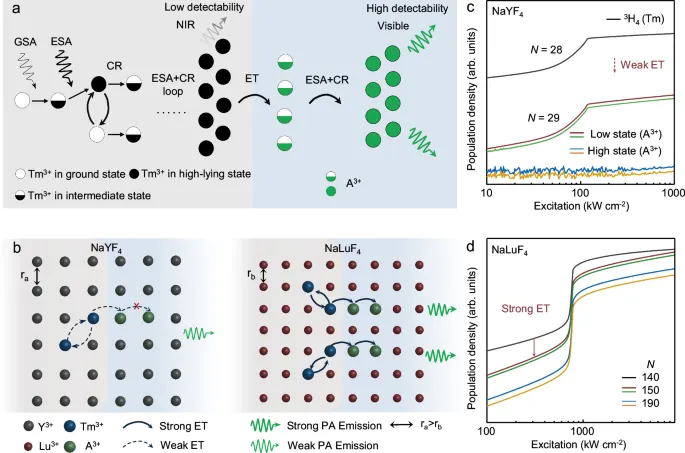
Researchers report in Nature Communications a way to move the very strong light response of photon avalanche nanoparticles from the near-infrared into visible colors, which standard detectors pick up well. With this approach, called cascade amplified photon avalanche (CAPA), they imaged single nanoparticles at a resolution of 28.3 nanometers using just one continuous-wave laser beam at 1064 nm.
Photon avalanche happens in nanoparticles doped with lanthanide ions. Energy loops with positive feedback pile up atoms in excited states, so a small change in laser power produces a huge change in brightness. Because of this steep response, light comes only from the very center of the laser spot, which sharpens images past the usual diffraction limit. The best earlier particles, doped with thulium (Tm3+), emitted in an 800-nm near-infrared band that standard detectors handle poorly. Earlier attempts to shift that emission to other colors lost nonlinearity and gave faint visible light.
In the new design, the authors placed erbium or holmium ions in the particle's core and surrounded it with a thulium-doped shell. The visible emission reached a nonlinearity above 150. The setup's diffraction limit was about 367 nm. Thulium-only particles imaged in the 800-nm band reached just 72 nm. Each pixel needed only 200 μs, compared with more than 10 ms in earlier thulium systems.
The team also labeled HepG2 cells with coated nanoparticles. These kept a nonlinearity above 100 in water and resolved subcellular filament-like structures attached to the cell surface at below 50 nm, with a full width at half maximum of 44 nm in the erbium green emission channel. The team also showed two-color subcellular imaging without crosstalk between colors, at resolutions of 56.3 nm and 63.5 nm. Live cells looked intact after 2 hours under 1 MW cm−2 of 1064-nm light, the researchers report.
Why it matters
The authors say that pairing a very strong nonlinear response with visible light that detectors capture efficiently opens a route to simpler, faster super-resolution microscopy, including multicolor imaging of subcellular structures.
What we don't know yet
The researchers note that CAPA needs a higher laser power density than conventional photon avalanche systems, though they say it is still much lower than the power used in STED and multiphoton microscopy.
Terms in this story
- Photon avalanche
- A process in certain doped materials where feedback loops of energy transfer cause light emission to rise extremely steeply as laser power increases.
- Diffraction limit
- The smallest detail a conventional light microscope can distinguish, set by the wavelength of light.
- Nonlinearity
- A measure of how much faster emitted brightness grows than the excitation power; higher values give sharper images.
Sources and verification
DexScience articles are produced with AI assistance and an automated fact-check against the linked sources. Spotted an error? Tell us and we will correct it openly.