Key points
- Chiara Cecchini of the University of Trento and colleagues tested whether amplitude statistics could reveal the gravitational-wave background's origin.
- Their simulations included several supermassive black hole populations and a primordial background that looks the same in every direction (isotropic).
- Even after accounting for noise, the simulated pulsar timing data always pointed to a Gaussian amplitude distribution.
- Sky-direction differences remain a possible way to separate the sources; the amplitude test needs extra assumptions.
A test that researchers hoped could reveal the origin of a faint, low-frequency gravitational-wave background falls short with pulsar timing data, at least without extra assumptions, according to Chiara Cecchini of the University of Trento in Italy and her colleagues. Their analysis, featured in a synopsis in the American Physical Society's Physics magazine, finds that pulsar measurements are insensitive to the amplitude patterns that were supposed to distinguish competing explanations.
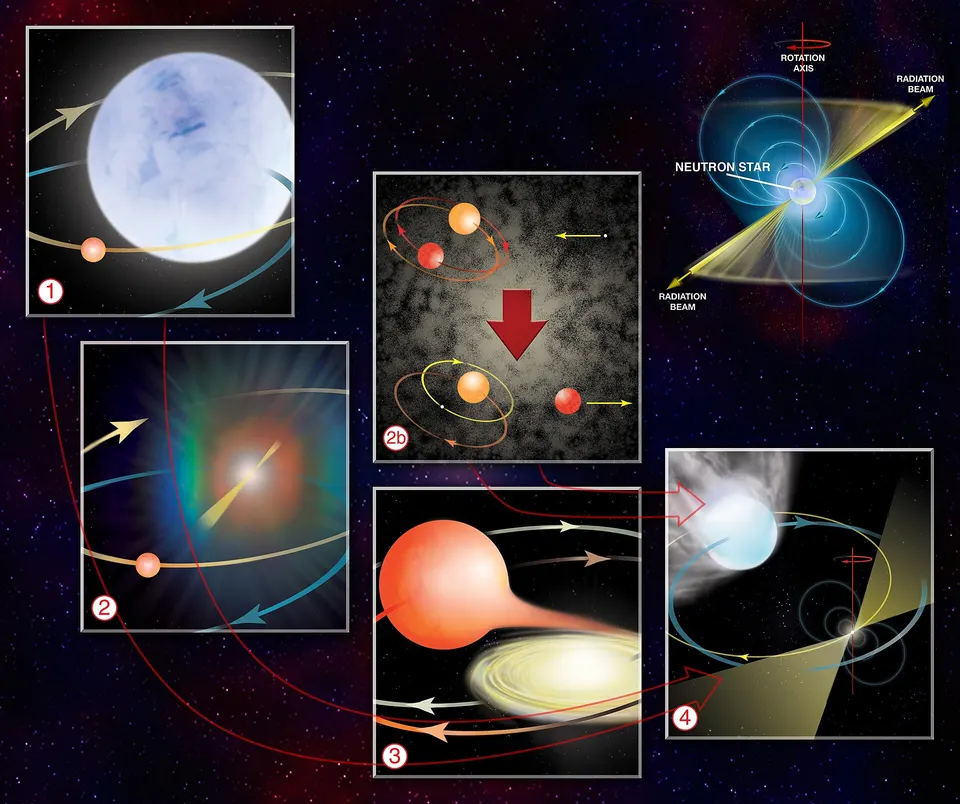
Millisecond pulsars are fast-spinning, strongly magnetized neutron stars whose pulses radio telescopes on Earth pick up. When pulses from a hundred or so of these stars arrive slightly early or late in a coordinated way, that points to passing gravitational waves. In 2023, collaborations using these pulsar timing arrays, which are sensitive to frequencies up to 100 nanohertz, began reporting this background.
There are two leading explanations. Pairs of supermassive black holes that orbit each other for millions of years would create a background that differs across the sky and has a non-Gaussian amplitude distribution. Inflation and other early-Universe processes would instead create a background that looks the same in every direction, with a Gaussian amplitude distribution, the familiar bell curve. The team simulated how pulsars would respond to several black-hole populations and to a primordial background, then used statistical tools to work backward to the amplitude distribution. Even after accounting for noise, every simulated dataset pointed to a Gaussian distribution.
The result does not rule out using differences across the sky to tell the sources apart. Instead, it suggests that non-Gaussian patterns can't serve as a diagnostic unless researchers make additional assumptions about the sources.
Why it matters
Since 2023, researchers have been trying to identify the source of the gravitational-wave background. This work suggests that one promising approach can't do that on its own: researchers will need additional assumptions about the sources or other signs, such as differences across the sky.
What we don't know yet
The finding comes from simulated pulsar timing data. The synopsis notes that differences across the sky may still separate black-hole and primordial signals, and that the non-Gaussian test could work only with additional assumptions about the sources.
Terms in this story
- Pulsar timing array
- A set of millisecond pulsars whose pulse arrival times are monitored together to detect very low-frequency gravitational waves.
- Gaussian distribution
- A bell-shaped spread of values in which most values cluster near the average and extreme values are rare.
- Isotropic
- The same in every direction.
Sources and verification
DexScience articles are produced with AI assistance and an automated fact-check against the linked sources. Spotted an error? Tell us and we will correct it openly.