Key points
- The simulator uses a two-dimensional Bose–Einstein condensate of 39K atoms held in an optical box trap.
- Radio-frequency coupling between two hyperfine states gives the simulated field an effective mass that the team can tune.
- The measured link between ripple frequency and wavelength agreed well with theoretical predictions for several field masses.
- Earlier realizations of the sine-Gordon model were limited to one dimension, where the uniform model is integrable.
Physicists have turned a flat cloud of ultracold potassium atoms into a stand-in for massive relativistic quantum fields that spread across two spatial dimensions, the team reports in Nature. These analogue simulators let researchers study quantum field theories tied to settings that cannot be reached directly, such as the early Universe. Earlier realizations of this particular theory, called the sine-Gordon model, worked in only one dimension.
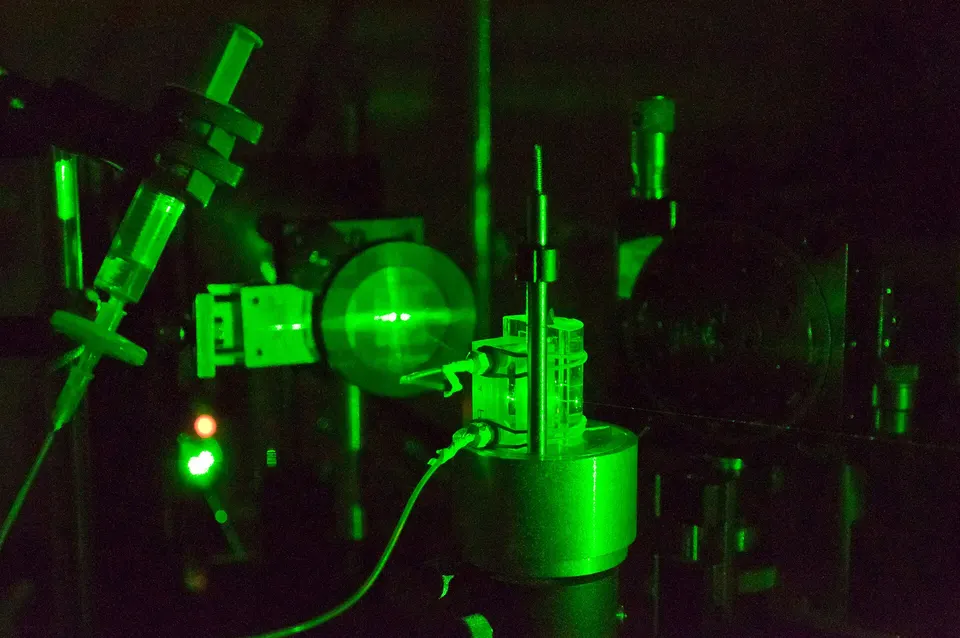
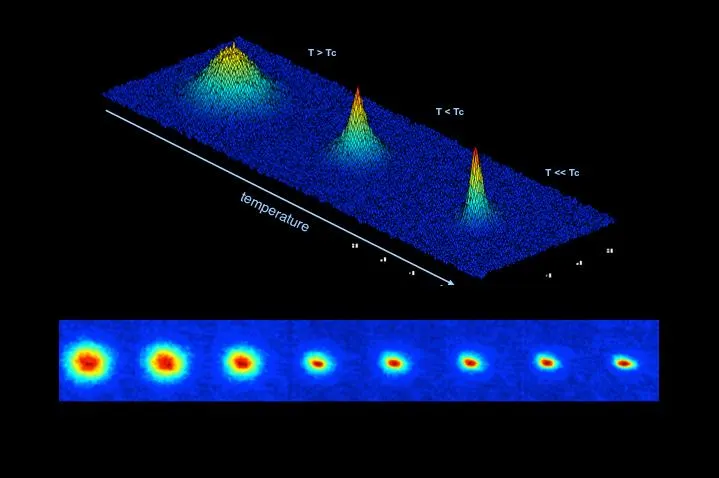
The simulator is a Bose–Einstein condensate, a gas cooled until its atoms share one quantum state. It is made of 39K atoms held in a two-dimensional optical box trap, at a temperature the team estimates at ≲10 nK. Each atom is in a mixture of two hyperfine states, which a radio-frequency field links coherently.
The total density stays essentially uniform. Meanwhile, the relative phase between the two states changes from place to place and plays the part of the field. The coupling gives that field a mass, and the researchers can tune the mass by changing the coupling strength.
To test the physics, the team modulated the coupling to create ripples with well-defined wavelengths. They then charted how each ripple's frequency depends on its wavelength, for several field masses. The measurements matched theoretical predictions well. At long wavelengths, the relation approximates the one expected for a massive relativistic particle. The researchers also report seeing the field behave in both the gentle, small-ripple regime and the strongly nonlinear regime, which they reached by starting the phase far from its resting value.
Adding a second dimension matters because domain walls, places where the phase winds through a full turn, stop being points. Instead they become extended objects that can form complex patterns. The setup also proved forgiving: the gas settles into the right balance of states on its own, and interactions between the atoms make it less sensitive to magnetic-field errors.
Why it matters
Analogue simulators can follow quantum fields as they evolve over time, a kind of many-body dynamics the authors say is computationally hard to calculate. They also give experimental access to field theories tied to settings such as the early Universe.
What we don't know yet
The simulated field behaves approximately relativistically only at long wavelengths, below a wavenumber of about 2.6 μm−1 in this system. This is an analogue experiment in a cold-atom gas, not an observation of the early Universe itself.
Terms in this story
- Bose–Einstein condensate
- A gas of atoms cooled so far that they collectively occupy a single quantum state and behave like one wave.
- Sine-Gordon model
- A standard theory of a massive relativistic field whose energy changes like a cosine as the field shifts, which allows features such as domain walls.
- Analogue simulation
- Using a controllable lab system that obeys the same equations as a hard-to-reach physical system in order to study that system's behavior.
Sources and verification
DexScience articles are produced with AI assistance and an automated fact-check against the linked sources. Spotted an error? Tell us and we will correct it openly.