Key points
- The team tested direct ocean removal of CO2 in many regions and four seasons using CESM2's ocean model.
- Efficiency was higher for removal done in summer than in winter. The gap was largest in the first years.
- Equatorial and subpolar waters responded fastest. High-latitude deep-water formation regions were the least efficient.
- After 15 years, efficiency reached about 1 in most subpolar and equatorial regions but stayed below 1 in subtropical and high-latitude waters.
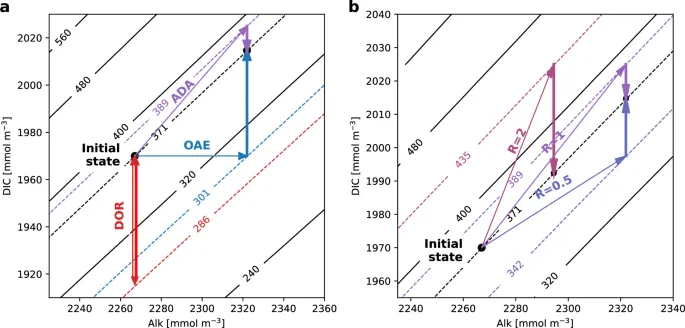
A team using a global ocean model has mapped how strongly one marine carbon removal method draws CO2 back down from the air. The researchers report in Nature Communications that the answer depends heavily on where and when the method is used. The method is called direct ocean removal (DOR). The authors note that recent model studies have mapped the efficiency of ocean alkalinity enhancement (OAE), a related approach that adds alkaline material to seawater, but that comparable global and seasonal mapping had not been done for DOR.
In DOR, an industrial process pulls CO2 out of seawater and sends it to storage. The treated water, now short of carbon, is returned to the surface. There it slowly absorbs carbon dioxide from the atmosphere until it comes back into balance. The method's efficiency measures how far that refilling has gone.
For their simulations, the researchers relied on the ocean part of a climate model known as the Community Earth System Model version 2 (CESM2). They tested DOR in a range of ocean regions and in each of four seasons, then tracked how the water responded over 15 years.
Removal done in summer was more efficient than removal done in winter. This seasonal gap was largest early on and shrank over time. Equatorial and subpolar waters made up the CO2 deficit fastest, followed by the subtropics. High-latitude regions where deep water forms performed worst, because the treated water sinks quickly and loses contact with the atmosphere.
After 15 years, efficiency reached about 1, its theoretical maximum, in most subpolar and equatorial areas. In subtropical and high-latitude waters it stayed below 1.
These patterns resemble earlier maps for OAE. The researchers say this is because both methods work by leaving surface water short of CO2, so the same processes drive the recovery. The team also combined the two sets of simulations to estimate efficiencies for weathering-based approaches such as enhanced rock weathering, which deliver both alkalinity and carbon to the sea. They ran separate simulations of those combined additions to check that the shortcut works.
Why it matters
According to the authors, mapping what happens in the ocean, including how much ocean CO2 outgassing may offset the CO2 first captured and how this varies by place and season, is crucial for full life cycle assessments of weathering-based approaches such as enhanced rock weathering.
What we don't know yet
These are model simulations, and the 15-year runs capture only the near-term response. The authors note that the net climate benefit of these approaches also depends on emissions from producing, processing and transporting materials, and on their effects on marine environments. Both still require full assessment.
Terms in this story
- Direct ocean removal (DOR)
- An industrial process that extracts CO2 from seawater for storage, then returns the depleted water to the sea so it can absorb more CO2 from the air.
- Ocean alkalinity enhancement (OAE)
- A method that adds alkaline material to seawater so the ocean takes up extra CO2 from the atmosphere.
- Deep-water formation
- The sinking of dense surface water into the deep ocean, mostly at high latitudes.
Sources and verification
DexScience articles are produced with AI assistance and an automated fact-check against the linked sources. Spotted an error? Tell us and we will correct it openly.