Key points
- Tandem cells using the new junction reached a certified power conversion efficiency of 28.94% on a 0.2036 cm2 device.
- The best cell reached a maximum efficiency of 29.60%, according to the researchers.
- Devices kept 98% of their initial efficiency after 1000 hours of maximum power point tracking.
- Ordered molecular patches speed up charge flow, while the disordered regions around them suppress ion migration.
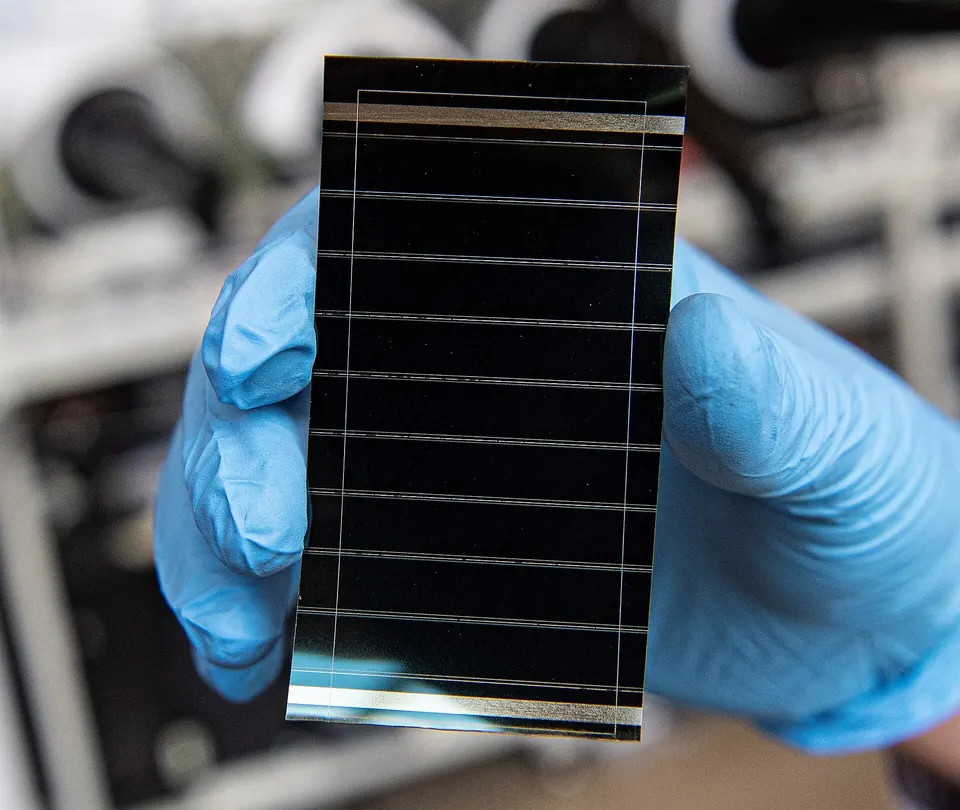
Researchers have redesigned the thin layer that joins the two halves of a stacked perovskite/CIGS solar cell, and they report high efficiency and good durability. Devices built with the new layer reached a certified power conversion efficiency of 28.94% and kept 98% of their starting efficiency after 1000 hours of maximum power point tracking. The work appears in a peer-reviewed paper published by Wiley-VCH.
In these monolithic tandem cells, a perovskite top cell is built directly on a bottom cell made of copper indium gallium selenide, or CIGS. A tandem design lets each layer capture a different part of the sunlight. The two cells are connected by a recombination junction, where charges arriving from each cell meet and cancel out. According to the authors, laying down an even junction on the rough CIGS surface while also keeping charges moving and making the device durable has been hard.
To tackle this, the team combined a self-assembled molecule with a polymeric self-assembled molecule called PCCP. The two attract each other through π–π interactions, a stacking force between flat, ring-shaped parts of molecules, and form small patches where the molecules line up. Inside these patches the molecules sit closer together, which helps charges travel faster. The disordered material around the patches breaks up the routes that mobile ions would otherwise follow. The researchers say the coating also covers the bumpy CIGS surface evenly and holds up better in service.
The best cell reached a maximum efficiency of 29.60%. The authors argue that short-range molecular ordering is an effective way to build efficient, long-lasting junctions in monolithic tandem solar cells.
Why it matters
The recombination junction controls both the efficiency and the operating stability of monolithic tandem cells, and perovskite/CIGS tandems are seen as a promising option for next-generation photovoltaics.
What we don't know yet
The certified result comes from a small laboratory device with an area of 0.2036 cm2. The source does not report any tests on larger cells.
Terms in this story
- Recombination junction
- The connecting layer in a stacked solar cell where charges from the top and bottom cells meet and cancel, letting current flow through both.
- Self-assembled molecule
- A molecule that arranges itself into a thin, organized coating on a surface without outside direction.
- Maximum power point tracking
- A test that keeps a solar cell running at the operating point where it delivers the most power, used to measure stability over time.
Sources and verification
DexScience articles are produced with AI assistance and an automated fact-check against the linked sources. Spotted an error? Tell us and we will correct it openly.