Key points
- Monolithic all-perovskite tandem cells reached 31.1% power conversion efficiency, certified at 30.8%.
- The additive p-aminobenzohydrazide (ABH) was mixed into the PEDOT:PSS hole transport layer of the tin-lead subcell.
- During fabrication, ABH reduces Sn4+ defects and converts into p-aminobenzaldehyde, which guards against further tin oxidation.
- Tested alone, the tin-lead cell hit 25.4% efficiency, independently certified at 25.2%, and an 83.4% fill factor.
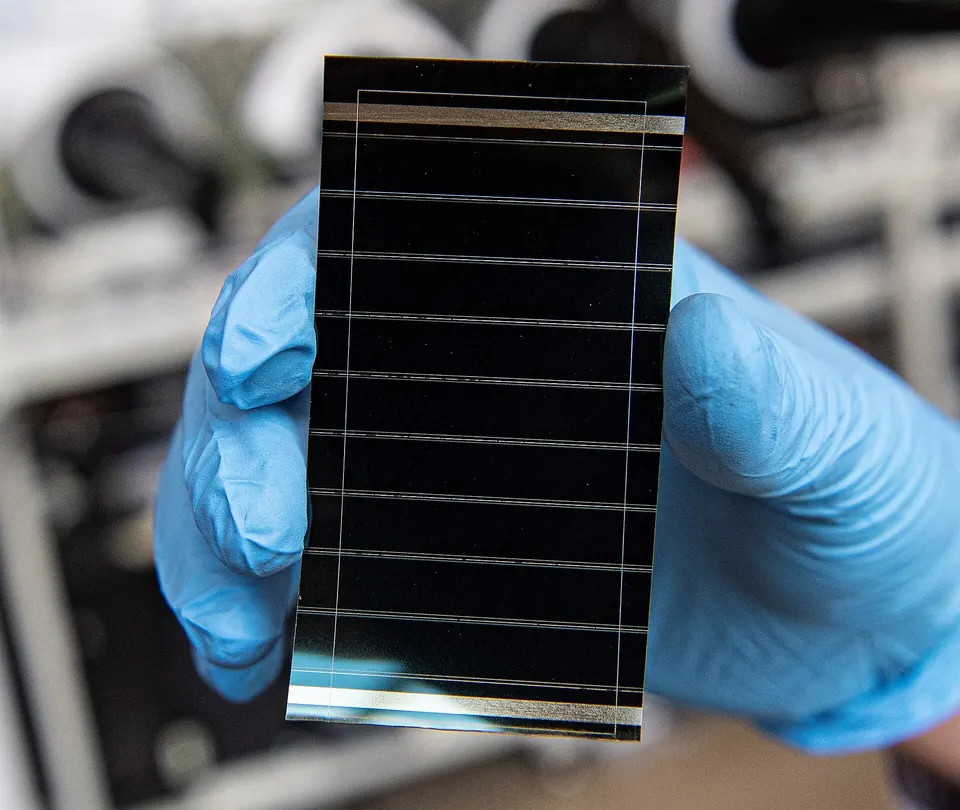
Researchers report in Nature that adding a small organic molecule to one layer of a tin-lead perovskite solar cell pushed the efficiency of all-perovskite tandem devices to 31.1%, with an independently certified value of 30.8%. The team, whose authors include Shaomin Yang and Xiong Li, says the additive also made the cells more stable.
A tandem cell stacks two light absorbers that capture different parts of the spectrum, which lets it beat the efficiency ceiling of a single perovskite layer. In this design the weak spot is the bottom tin-lead subcell. That is where the perovskite meets PEDOT:PSS, a polymer that carries positive charges, called holes, out of the device. Tin at this buried boundary oxidizes easily, and the resulting defects waste energy that could otherwise become electricity.
To fix this, the team blended p-aminobenzohydrazide (ABH) into the polymer. According to the paper, ABH neutralizes the acidity of the PSS component and reverses tin oxidation by reducing Sn4+ defects while the perovskite is being made. As it does so, it turns into p-aminobenzaldehyde. This new molecule resists tin oxidation driven by light-generated holes and aligns energy levels so holes can be pulled out efficiently.
On its own, the tin-lead cell reached 25.4% efficiency, a figure independent certification put at 25.2%. It delivered 0.92 V when no current was drawn, a quantity known as open-circuit voltage, and its fill factor came in at 83.4%. Once built into tandems, the devices held up better in heat tests at 85 °C and during operation. The researchers ran those stability tests under inert conditions.
Why it matters
According to the authors, instability where the hole transport layer meets the tin-lead perovskite limits both the efficiency and the durability of all-perovskite tandems. This additive targets that problem during fabrication and during operation.
What we don't know yet
The thermal and operational stability gains were measured under inert conditions, not in open air. The paper is an accepted early version that may still be edited before the final Version of Record.
Terms in this story
- Tandem solar cell
- A device that stacks two light-absorbing layers, each tuned to different wavelengths, to turn more sunlight into electricity.
- Hole transport layer
- A layer that pulls positive charges out of the light absorber and carries them toward an electrode.
- Fill factor
- A measure of how closely a solar cell's real power output comes to its theoretical maximum for its voltage and current.
Sources and verification
DexScience articles are produced with AI assistance and an automated fact-check against the linked sources. Spotted an error? Tell us and we will correct it openly.