Key points
- NV centers about 8 nm below a diamond surface sensed deuterium in films of PMMA-d₈ and phenanthrene-d₁₀.
- Spectra were recorded at 188 mT, compared with 11.75 T for the conventional bulk NMR benchmark.
- For PMMA-d₈, spin sensitivity improved from about 3×10^20 to 3×10^13 spins √Hz⁻¹, more than seven orders of magnitude.
- The measured gyromagnetic ratio, 6.61 ± 0.18 MHz T⁻¹, matched deuterium's known value of 6.536 MHz T⁻¹.
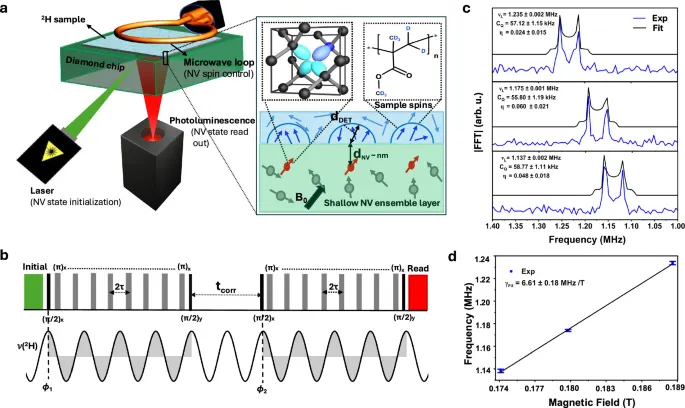
Using tiny magnetic sensors built into diamond, researchers have recorded deuterium NMR spectra from nanoscale detection volumes. The spectra closely resemble those from conventional bulk instruments, yet they were taken at a magnetic field of just 188 mT, the team reports in Nature Communications. The sensors are nitrogen-vacancy (NV) centers. These are atomic-scale flaws in the diamond crystal, and their electron spins respond to very faint magnetic signals.
The researchers placed a group of NV centers roughly 8 nm beneath the surface of a diamond chip. They then coated the chip with two deuterated materials: a polymer, PMMA-d₈, and a molecular solid, phenanthrene-d₁₀. The sensors need no radio pulses to excite the nuclei. Instead, they pick up the natural, random fluctuations of nearby deuterium spins. The resulting spectra showed Pake patterns, distinctive line shapes that carry information about how molecules are arranged and how they move. The signal's measured gyromagnetic ratio, 6.61 ± 0.18 MHz T⁻¹, agreed with deuterium's known value of 6.536 MHz T⁻¹, which confirms the signal came from deuterium.
The team compared the results with bulk NMR performed at 11.75 T. For PMMA-d₈, spin sensitivity improved from about 3×10^20 to about 3×10^13 spins √Hz⁻¹, a gain of more than seven orders of magnitude. For phenanthrene-d₁₀, the gain was roughly eight orders. According to the authors, the method opens the door to studying molecular dynamics at the nanoscale.
Some gaps remain. In the PMMA-d₈ spectrum, a weaker signal from one chemical group was missing, probably because it was lost in the noise. The pulse sequence also limits how broad a signal can be detected. For phenanthrene-d₁₀, the coupling constants differed from the bulk values, possibly because the molecules pack or orient differently at the diamond surface.
Why it matters
The approach measures information-rich deuterium line shapes from nanoscale volumes without the high magnetic fields that conventional NMR usually requires, which could make it possible to study molecular motion at the nanoscale.
What we don't know yet
The pulse sequence's filter of about 80 kHz limits detection of broad signals. The authors suggest combining datasets taken with different pulse spacings could help. The large ²H frequency shift in the bulk phenanthrene-d₁₀ spectrum, and the origin of the paramagnetism found in that sample, need further investigation.
Terms in this story
- Nitrogen-vacancy (NV) center
- A defect in diamond where a nitrogen atom sits beside a missing carbon atom, creating an electron spin that can be read with light and works as a sensitive magnetometer.
- Deuterium
- A heavy form of hydrogen whose nucleus contains one proton and one neutron.
- Pake pattern
- A characteristic broad NMR line shape from solid samples that reflects the orientation and motion of molecules.
Sources and verification
- Quantum sensing-enabled deuterium NMR spectroscopy with nanoscale sensitivity at low magnetic fields
DexScience articles are produced with AI assistance and an automated fact-check against the linked sources. Spotted an error? Tell us and we will correct it openly.