Key points
- Packaged viral RNA polymerase appears as a 1.8-megadalton resting-state dimer, bridged by vaccinia virus early transcription factor.
- In some dimers, the kinase VPK2 and core protein L4 tether the machinery to the genome near the inner core wall.
- A sub-nanometer structure shows an E8 hexameric crown, E6 hexameric hub and L3 dodecameric channel in the core wall.
- Work used cryo-electron tomography and sub-tomogram averaging on purified Vaccinia virus cores; reported in Nature.
Poxviruses do something unusual for a virus: they bring their own factory. Packed inside each particle, alongside a double-stranded DNA genome, is a complete set of machinery for copying genes into messenger RNA. A study published in Nature on 23 November 2026 now shows how that factory is arranged while still sealed inside the virus, and describes the structure of the gateway through which its products appear to leave.
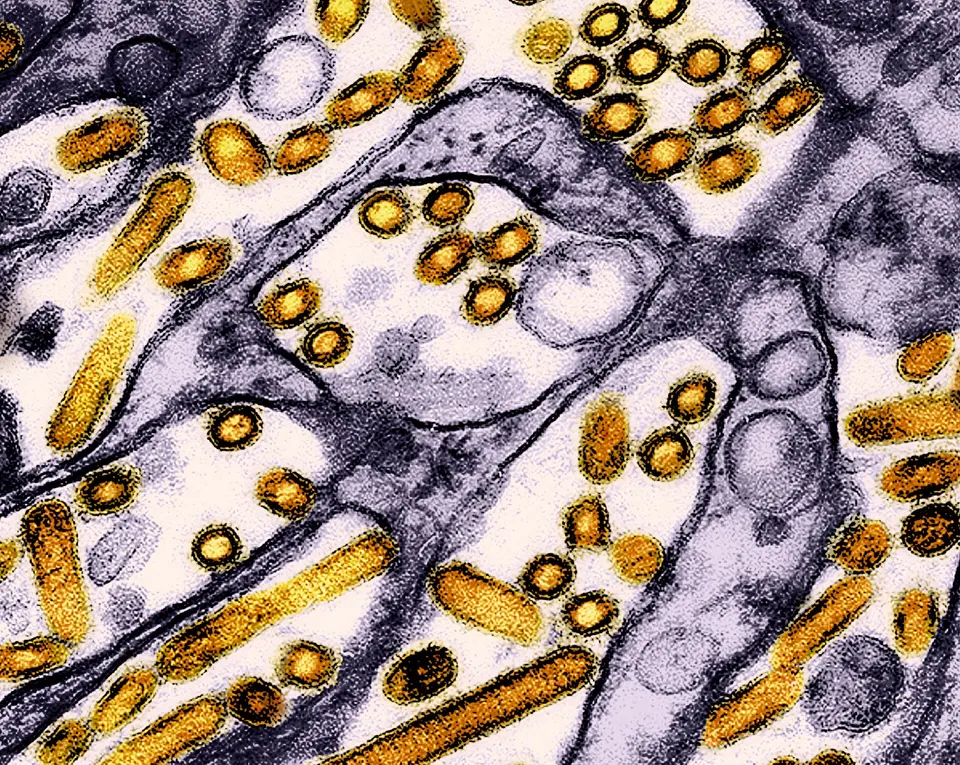
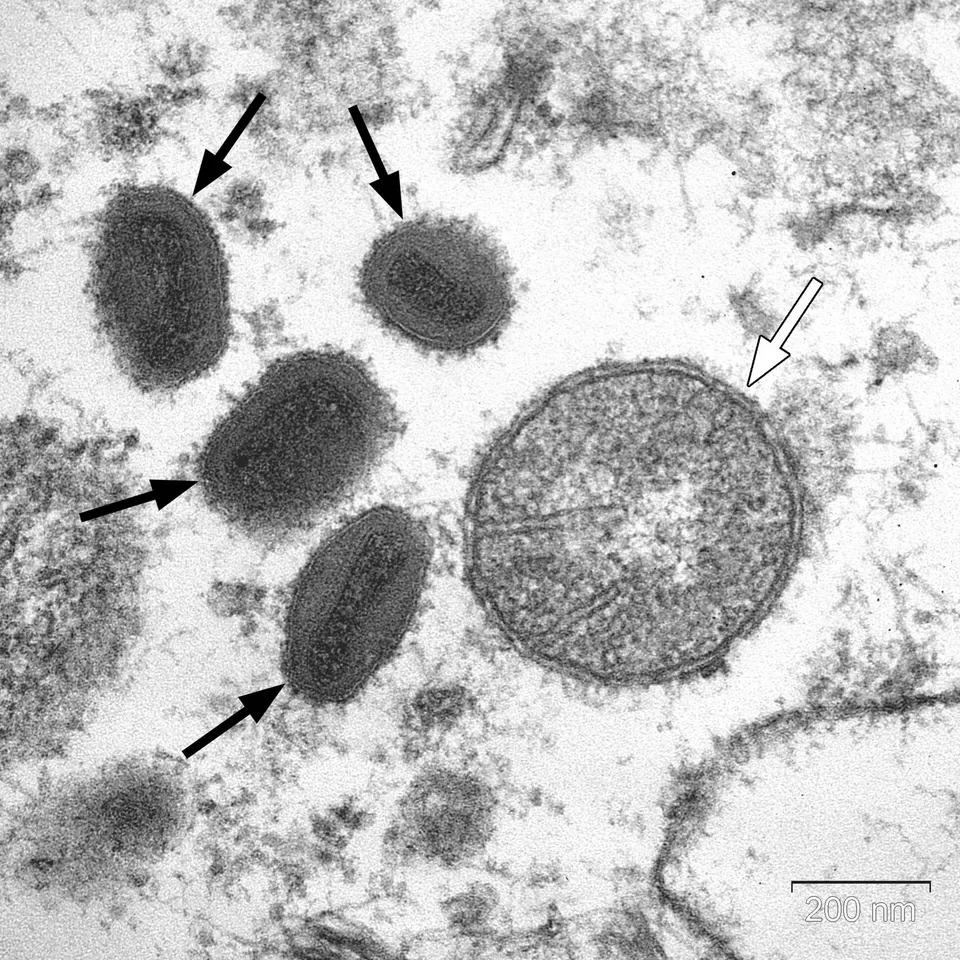
The researchers worked with purified cores of Vaccinia virus, the poxvirus used as the standard laboratory model for the group. The core is the inner compartment of the virus, bounded by what the authors describe as a permeable, multi-layered protein shell, and it is capable of carrying out transcription on its own. When a poxvirus infects a cell and releases its core, the enclosed machinery begins making early messenger RNAs almost immediately, and those RNAs are pushed out across the core wall into the surrounding cell fluid, where they can be translated into protein.
To see inside, the team used cryo-electron tomography combined with sub-tomogram averaging — an approach that captures many tilted views of frozen samples, then computationally aligns and averages thousands of copies of the same structure to sharpen it. Structures of the isolated viral DNA-dependent RNA polymerase, or vRNAP, had been determined before in the test tube. What was missing, the authors write, was its native organization in virio: how it sits, and what it touches, while still inside an intact core.
The central surprise is that the packaged polymerase is not a single working unit. Instead the enzyme sits as a dimer — two copies joined together — with a combined mass of 1.8 megadaltons, which the authors characterize as a resting state. Holding the pair together is fully ordered vaccinia virus early transcription factor, or VETF, a protein normally associated with switching on early gene transcription. In a subset of these dimers, the researchers also found the essential kinase VPK2 and the core protein L4 attached. Those two proteins directly tether the transcription machinery to the packaged genome, close to the inner surface of the core wall.
The second structure in the paper is of the complex the team puts forward as the likely exit route for newly made messenger RNA. Resolved at sub-nanometer detail, it is a rigid assembly built into the core wall itself, with three stacked layers: a crown made of six copies of the protein E8, a central hub made of six copies of E6, and, at the base, a channel formed by twelve copies of L3. That basal channel, the researchers say, is suited to the export of nucleic acid. They describe the portal as putative, meaning the assignment of function follows from its architecture and position rather than from a direct demonstration that RNA passes through it.
Taken together, the authors present the work as an architectural blueprint for important components of the poxvirus core, linking the genome, the enzymes that read it, and the wall that both contains and releases their output. They suggest it opens structural and functional lines of inquiry into how poxvirus genomes are packaged, how transcription is switched on, and how messenger RNA is extruded — questions that have been difficult to approach without a picture of the intact, loaded core.
Why it matters
Poxviruses carry their own transcription machinery, and until now its arrangement inside an intact viral core was unknown. The authors say the structures give an architectural blueprint for studying how these genomes are packaged, how transcription starts, and how messenger RNA gets out.
What we don't know yet
The mRNA exit complex is described as putative: its role is inferred from its architecture and position in the core wall, not from a direct demonstration of RNA passing through. The work was done on purified Vaccinia virus cores, the standard laboratory model for poxviruses.
Terms in this story
- Cryo-electron tomography
- An imaging method that takes many tilted views of a rapidly frozen sample and reconstructs them into a three-dimensional picture.
- Sub-tomogram averaging
- A computational step that aligns and averages many copies of the same structure from tomograms to reveal finer detail.
- Megadalton
- A unit of molecular mass; one megadalton equals one million daltons, and large protein assemblies are often measured in these units.
Sources and verification
DexScience articles are produced with AI assistance and an automated fact-check against the linked sources. Spotted an error? Tell us and we will correct it openly.