Key points
- The team used about 2.7 ± 0.1 × 10^5 lithium-6 atoms flowing between two reservoirs through a light-shaped channel.
- A digital micromirror device let researchers set channel width as small as 0.9 ± 0.5 μm or as large as 19.8 ± 0.5 μm.
- Narrow channels showed signs of phase slips matching LAMH theory; wide channels behaved as expected for vortex-driven dissipation.
- In the crossover between the two regimes, making the channel wider increased its resistance.
Superfluids are supposed to flow without friction, but in thin geometries they can still lose energy. Researchers reporting in Nature have used a cloud of ultracold atoms to probe how that loss depends on the shape of the path, and they found a twist: within a certain range of sizes, a wider channel resists flow more, not less.
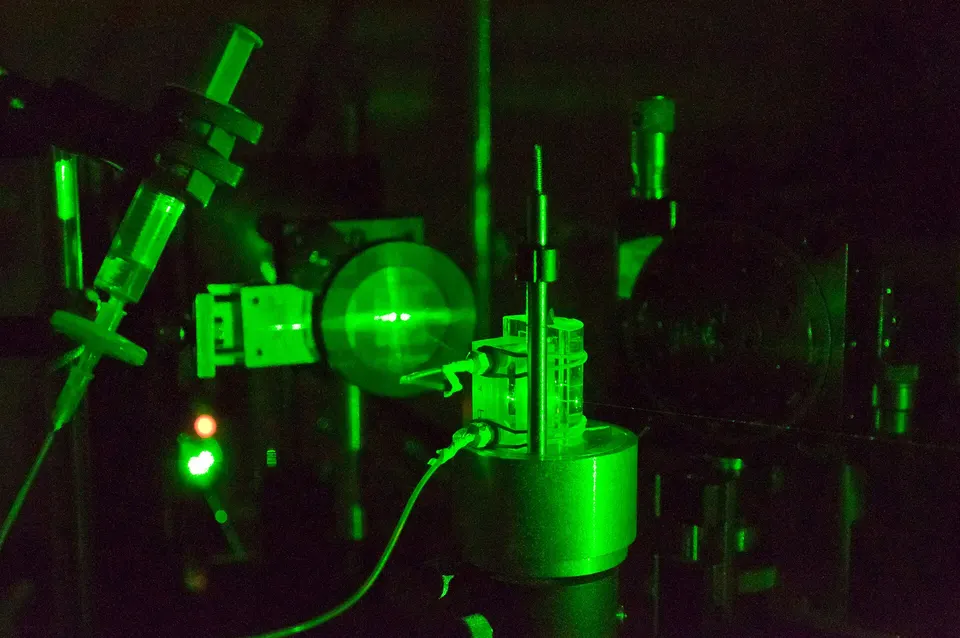
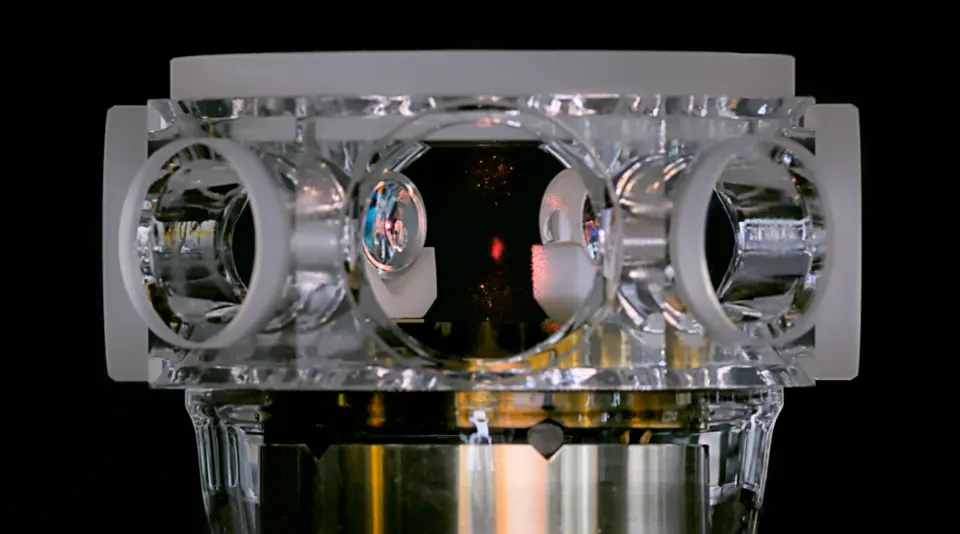
The experiment used strongly interacting lithium-6 atoms, a type of fermion, chilled and split into two reservoirs linked by a channel. A digital micromirror device, an array of tiny mirrors that patterns laser light, let the team make the channel as slim as 0.9 ± 0.5 μm or as broad as 19.8 ± 0.5 μm. The researchers set up an imbalance, with more atom pairs in one reservoir than the other, and tracked how it relaxed and oscillated over time.
In the narrowest channels, which behave almost like one-dimensional wires, the data carried signatures of phase slips, brief local breakdowns of the superfluid that bleed off energy. These matched Langer–Ambegaokar–McCumber–Halperin (LAMH) theory, with the phase-slip contribution falling exponentially across many orders of magnitude as the channel widened. In the widest channels, which act more like two-dimensional sheets, the behavior instead fit a model in which vortices, tiny whirlpools, carry away energy.
The surprise sits between those limits. There, the authors say, widening the channel paradoxically increases resistance, a regime they note is hard to capture with analytical models. They see the setup as a useful testbed for simulating how quantum fluids carry current away from equilibrium.
Why it matters
The tunable, defect-free channel lets researchers isolate how geometry alone shapes dissipation in low-dimensional superfluids, which the authors say had remained an unresolved experimental challenge.
What we don't know yet
The researchers say the crossover between one- and two-dimensional transport, where the paradox appears, is difficult to describe with analytical models.
Terms in this story
- Superfluid
- A state of matter that can flow without friction, sharing a single coordinated quantum phase across the whole fluid.
- Phase slip
- A brief, local collapse of a superfluid that lets its quantum phase jump and releases stored flow energy as heat.
- Vortex
- A tiny whirlpool in a superfluid around which the quantum phase winds by a full turn.
Sources and verification
DexScience articles are produced with AI assistance and an automated fact-check against the linked sources. Spotted an error? Tell us and we will correct it openly.