Key points
- Verifier stations stood 195 meters apart on the NIST campus in Boulder, Colorado, with the prover's claimed location between them.
- The test exchanged entangled photons and random numbers millions of times over a few minutes.
- Passing a loophole-free Bell test requires following random instructions, and reply timing reveals the prover's location.
- NIST physicist Scott Glancy says real-world use may be more than a decade away.
Researchers from the National Institute of Standards and Technology (NIST), working alongside an international group of partners, have used quantum physics to check whether someone is really where they say they are. Their method rests on a loophole-free Bell test, a strict check that two particles are more closely linked than ordinary physics would allow. According to NIST, it closes gaps that left earlier quantum location schemes open to cheaters. The team reports the work in Nature, and NIST physicist Krister Shalm calls it the first complete demonstration of such a protocol, even though researchers have pursued the goal for decades.
The stakes are easy to picture. NIST describes a corporate treasurer ordering a $50 million wire transfer and asks how a network could confirm that the command came from a secure terminal at headquarters rather than from a hacker's laptop on another continent. The agency says location checks of this kind could someday protect medical records, keep remote attackers away from power grids, nuclear plants and water treatment facilities, block unauthorized stock trades, and blunt phishing by phone or video. Shalm says the approach ties digital security to physical places, so only someone who can show they are at a site such as a bank could get into a system.
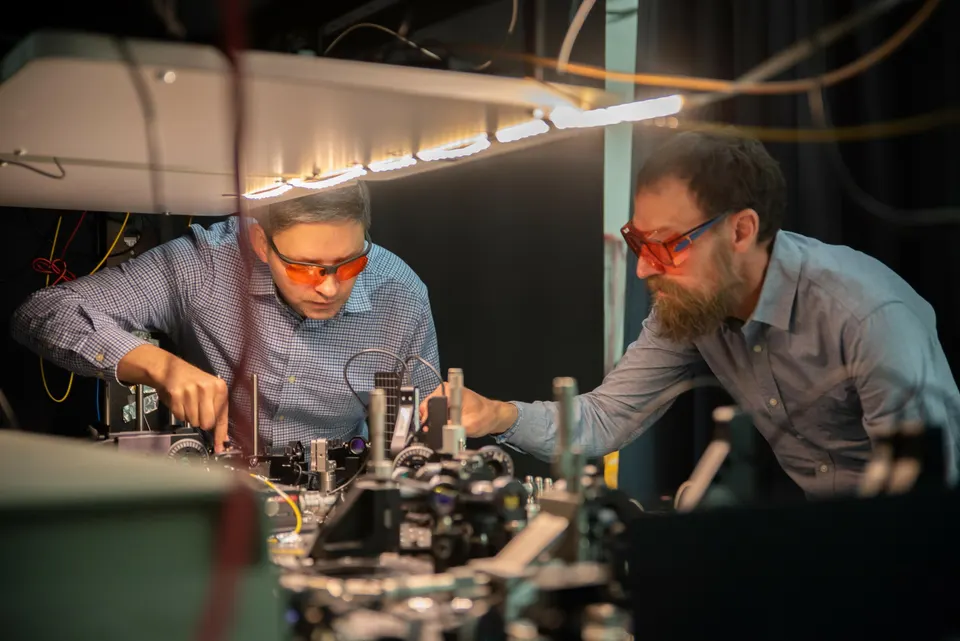
The procedure is called quantum position verification. Two trusted parties, the verifiers, try to confirm the location of a third party, the prover. On the Boulder campus, the team placed two verifier stations 195 meters apart. Electrical cables and thin optical fibers ran between them through a research building's hallways, and the prover's claimed position lay somewhere in between.
In each round, one verifier creates a pair of entangled photons, keeps one and sends the other to the prover. Entangled particles are linked so closely that measuring one reveals something about its partner. Both verifiers then send random numbers, timed to reach the prover's supposed location at the same moment. The prover uses those numbers to decide how to measure the photon's polarization, the direction in which its electric field oscillates, and reports the result. Because nothing travels faster than light, a prover who was farther away than claimed would answer too late. The team repeated this millions of times over a few minutes.
The verifiers then compare how often their own photon's measurements match the prover's. A quantum rule called the no-cloning theorem means anyone who tries to copy the information and share it with accomplices destroys those correlations. The random instructions also stop impostors from guessing ahead and replying early. NIST says any experimental error or tampering with the hardware makes the Bell test fail. A pass shows both that the prover is in the right place and that the devices worked as intended. The paper's title describes the devices as remote untrusted devices.
Several NIST technologies made the experiment possible. Superconducting nanowire single-photon detectors caught nearly every photon. That matters because if too many photons go missing, even an honest prover could not pass the Bell test. The team also used a fast, highly efficient source of entangled photons that NIST scientists built a decade ago.
Scott Glancy, a NIST physicist on the study, says real-world use may be more than a decade away. Proving to a customer that they are dealing with someone inside their bank's building would require high-fidelity quantum networks that share entangled photons between the two sides. Glancy notes that NIST and many other organizations and companies are working on that technology.
Why it matters
The researchers say the technique could tie digital access to a physical location. That would keep remote attackers away from sensitive systems such as financial accounts, health records and critical infrastructure.
What we don't know yet
According to study collaborator Scott Glancy, practical use may be more than a decade away. It depends on high-fidelity quantum communication networks that can share entangled photons over large distances, and those networks are still being developed.
Terms in this story
- Entanglement
- A quantum link between particles where measuring one immediately tells you something about the other, no matter how far apart they are.
- Loophole-free Bell test
- A carefully designed experiment showing that particles are more strongly correlated than classical physics permits, with no known gaps a cheater could exploit.
- Quantum position verification
- A method in which trusted verifiers use quantum signals and response times to confirm that a party is at a claimed location.
Sources and verification
- Quantum position verification with remote untrusted devices
- Quantum Physics Can Verify a Person’s Location, NIST Researchers Show
DexScience articles are produced with AI assistance and an automated fact-check against the linked sources. Spotted an error? Tell us and we will correct it openly.