Key points
- The new STRATIFY-CVD model uses 18 predictors and was built on records from 1,772,636 patients.
- Tested on 3,805,366 patients, it scored a C-statistic of 0.832 at 10 years.
- The model usually predicted lower cardiovascular risk than QRisk2, the tool used in UK practice during the study period.
- The team estimated events prevented or caused per 1,000 patients treated for 10 years, split by age, sex, frailty and past heart disease.
Guidelines tell doctors to balance the heart-protecting benefits of blood pressure drugs against possible harms, especially in frail older patients. The trouble, researchers say, is that there is little hard evidence on where that balance falls across a whole population. A team reporting in Nature Communications has built a modeling framework from electronic health records to estimate both sides at once.
Their first step was a new cardiovascular risk model, STRATIFY-CVD. Existing tools such as QRisk and SCORE were not designed for people aged 85 or older, people already taking statins, or people who have had heart disease before. They also ignore the chance that someone dies of another cause first, a factor known as the competing risk of death. The researchers developed their model using 1,772,636 patients from the Clinical Practice Research Datalink GOLD database. They then tested it on 3,805,366 patients from a separate database, CPRD Aurum. It performed well: its C-statistic, a measure of how well it ranks patients by risk, was 0.832 at 10 years. Its predictions also generally came in lower than those from QRisk2.
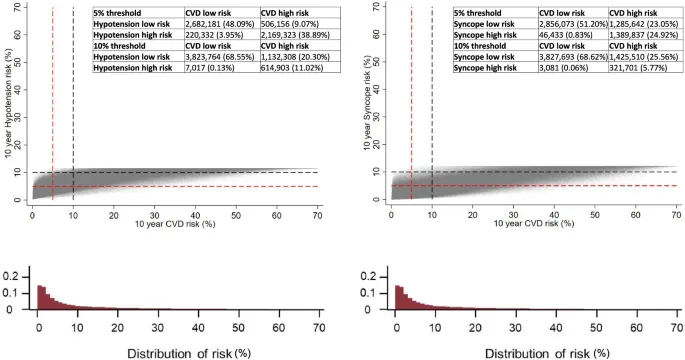
The team then paired this model with earlier STRATIFY models that predict six possible harms: low blood pressure (hypotension), fainting, falls, fractures, acute kidney injury and high blood potassium (hyperkalaemia). Using treatment effects drawn from meta-analyses of randomized trials, they estimated how many events treatment would prevent or cause per 1,000 people over 10 years. They broke these estimates down by age, sex, frailty and history of heart disease.
The analysis assumed every class of blood pressure drug has the same effect on these outcomes, and that this relative effect is the same for everyone, so only each person's starting risk differs.
Why it matters
Guidelines ask clinicians to weigh benefit against harm for older patients with frailty or several long-term conditions, but the authors note that there has been little evidence to support that judgment.
What we don't know yet
The estimates assume treatment effects are the same across drug classes and across the population, and those effects come from published trials and reviews rather than being measured directly.
Terms in this story
- C-statistic
- A score from 0.5 to 1 showing how well a model separates people who go on to have an event from those who do not.
- Competing risk of death
- The chance that a person dies of an unrelated cause before the outcome being predicted can happen.
- Hyperkalaemia
- An abnormally high level of potassium in the blood.
Sources and verification
DexScience articles are produced with AI assistance and an automated fact-check against the linked sources. Spotted an error? Tell us and we will correct it openly.