Key points
- The zone's southward extent was similar in ice ages and interglacials over the last ~265 thousand years.
- Nitrogen isotopes in foraminifera shells were not strongly correlated with global climate.
- The zone expanded briefly during the last three deglaciations and under certain orbital conditions.
- The results were published in Nature Geoscience by a team including M. L. Lacerra and D. M. Sigman.
An oxygen-starved layer of the eastern tropical North Pacific appears to have reached about as far south during ice ages as during warmer interglacial periods over the last ~265 thousand years. Researchers including M. L. Lacerra and D. M. Sigman report the result in Nature Geoscience. It challenges earlier interpretations of bulk seafloor sediment, which suggested the zone contracted during the late Pleistocene ice ages.
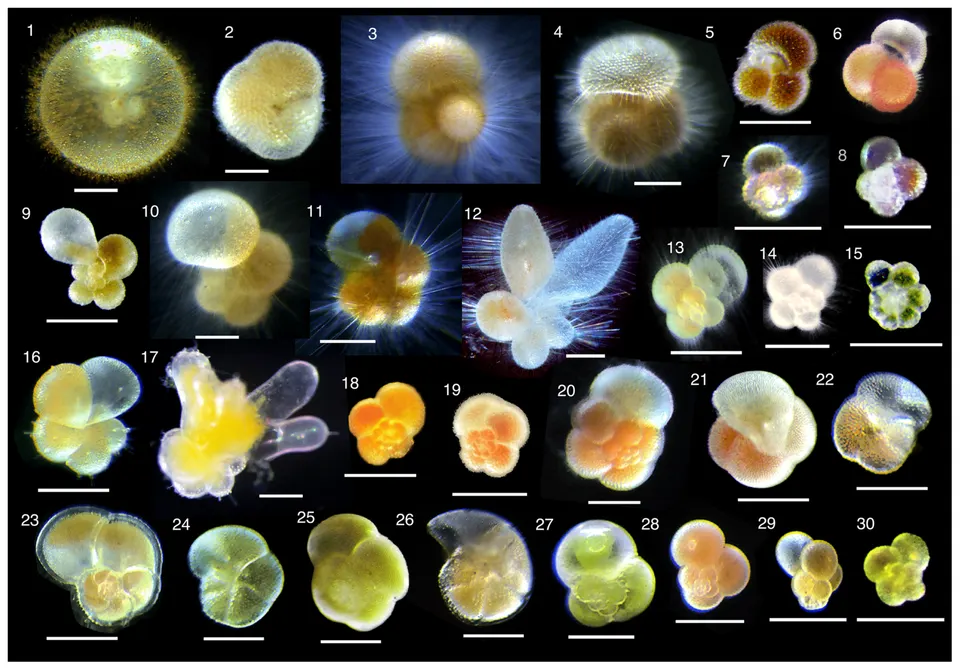
In these oxygen-deficient zones, denitrification removes nitrogen that marine life can use. The process favors the lighter isotope nitrogen-14, so the nitrate left behind becomes richer in nitrogen-15. The team measured this signal in nitrogen trapped inside the shells of foraminifera, tiny single-celled organisms, collected from the zone's southern margin. That shell record was not strongly correlated with global climate. The authors attribute the mismatch with bulk sediment from the same cores to chemical changes after burial or to nitrogen arriving from outside sources.
The zone did grow, but only temporarily. It expanded during the last three deglaciations and at other times when orbital conditions strengthened the intertropical convergence zone at its northern extreme. The researchers suggest that stronger wind-driven upwelling may have boosted surface productivity in those periods, enlarging the low-oxygen zone.
Foraminifera records from the earlier Cenozoic linked global cooling to an expanding zone. The team offers two possible reasons for the difference. Feedbacks that stabilize the tropical thermocline may have become important once it had strengthened to late Pleistocene levels. Alternatively, iron fertilization of the Southern Ocean may have reduced the nutrients reaching the tropics, offsetting processes that would otherwise expand the zone as the climate cooled.
Why it matters
Oxygen-deficient zones are hotspots of biogeochemical reactions, including denitrification, which removes biologically available nitrogen from the ocean. Knowing what controls their size over long periods helps explain how this nitrogen loss responds to climate.
What we don't know yet
The authors offer two possible explanations for why the zone did not respond to ice ages and do not say which one is correct. Their comparison also rests on the simplifying assumption that the offset between shell-bound nitrogen and subsurface nitrate stayed constant over time.
Terms in this story
- Denitrification
- A microbial process in low-oxygen water that converts nitrate into gas, removing nitrogen that marine life could otherwise use.
- Foraminifera
- Single-celled marine organisms with small shells that collect in seafloor sediments and preserve chemical clues about past oceans.
- Thermocline
- A layer of ocean water where temperature drops quickly with depth, separating warm surface water from colder deep water.
Sources and verification
DexScience articles are produced with AI assistance and an automated fact-check against the linked sources. Spotted an error? Tell us and we will correct it openly.