Key points
- A study in The Cryosphere examines how aerosol impurities change inside the EPICA Dome C ice core after deposition.
- The paper names three processes: dissolution, the formation of new minerals, and immobilization.
- The team used CFA-sp-ICP-TOFMS, a technique that analyzes melted ice particle by particle.
- The paper was published in The Cryosphere on 19 November 2026.
Tiny airborne particles trapped in Antarctic ice may not stay the same once they are buried. A study published on 19 November 2026 in the peer-reviewed journal The Cryosphere looks at geochemical changes that affect aerosol impurities in the EPICA Dome C ice core after they have settled. According to the paper's title, those changes involve dissolution, the growth of new minerals and immobilization.
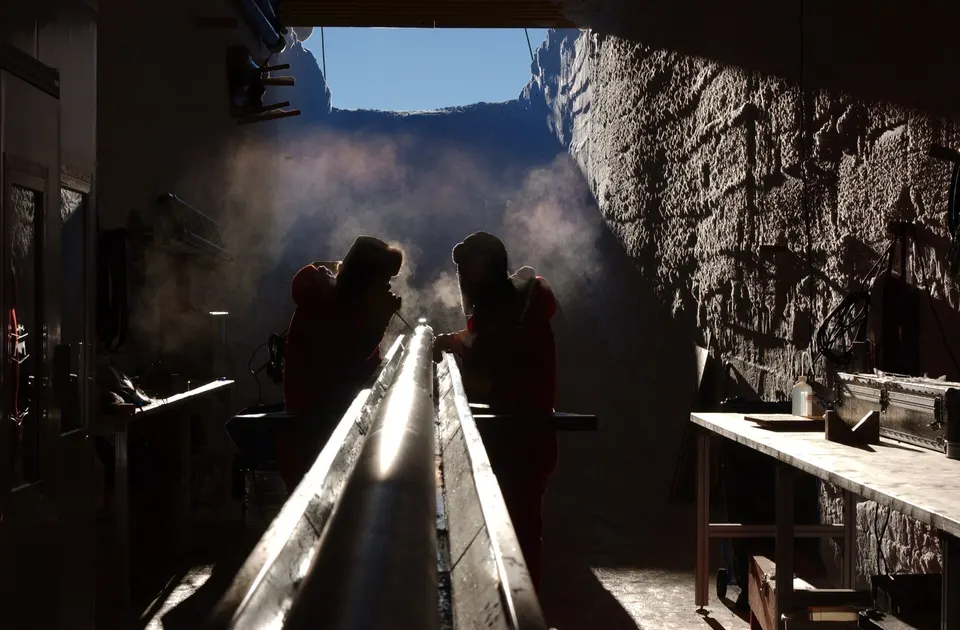
Ice cores hold dust, salts and other particles that fell with snow long ago, and scientists study them to reconstruct the atmosphere of the past. If those particles keep changing after burial, the chemistry measured today may not exactly match what originally fell from the sky.
To study the particles, the researchers used a method called CFA-sp-ICP-TOFMS. In continuous flow analysis, a length of ice core is melted in a steady stream. Single-particle mass spectrometry then measures the elements in individual grains as they flow past. The three processes named in the title are different ways particles can change. Some may dissolve, some may give rise to minerals that were not present when the snow fell, and some elements may end up fixed in place within the ice.
The source material available to DexScience is limited to the paper's title and publication details. It does not include the study's specific measurements, the depths sampled or how large the effects are. Readers who want those details should consult the full paper in The Cryosphere.
Why it matters
Ice cores like EPICA Dome C record past climate in the chemistry of their impurities. Changes that happen after deposition could alter how those records are read.
What we don't know yet
The material available for this article includes only the paper's title and publication details. Its specific findings, measurements and magnitudes are not reported here.
Terms in this story
- Aerosol
- Tiny solid or liquid particles, such as dust or sea salt, carried in the air.
- Mineral neoformation
- The growth of new minerals in place, made from material that was already present.
- Continuous flow analysis
- A method that melts an ice core in a steady stream so its meltwater can be measured continuously.
Sources and verification
DexScience articles are produced with AI assistance and an automated fact-check against the linked sources. Spotted an error? Tell us and we will correct it openly.