Key points
- Copper from hydrothermal vent minerals helped convert glycine into hydrogen cyanide in alkaline, oxygen-free water.
- The chimney sample came from the Iheya North Field in the Mid-Okinawa Trough, collected 1009.4 m deep.
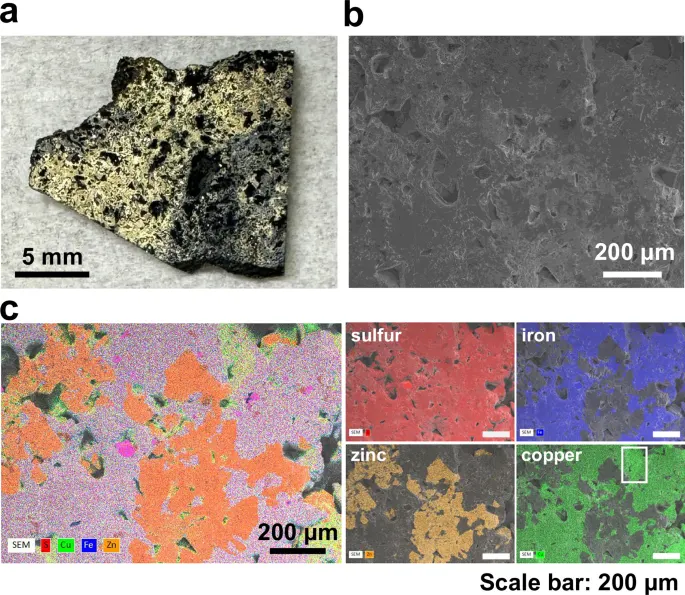
- The chimney material was mostly chalcopyrite, pyrite and sphalerite; elemental maps of polished slices showed small copper-rich patches.
- The experiments did not attempt to fully recreate the high temperatures and pressures of vent fluids.
Minerals from a deep-sea hydrothermal vent can turn the simple amino acid glycine into hydrogen cyanide (HCN) in alkaline, oxygen-free water, and copper from the vent minerals helps the reaction along, researchers report in Communications Chemistry. The result matters because HCN shows up in many proposed chemical routes to the building blocks of RNA and proteins. Vents, meanwhile, have generally been seen as poor places for free HCN to exist.
The team gives two reasons for that view. Making HCN in the air requires plenty of methane, but the early atmosphere was likely rich in carbon dioxide instead. And any cyanide that did reach an iron-rich ancient ocean would quickly have been locked up as ferrocyanide, a tightly bound iron complex.
To look for a local alternative, the researchers worked with a piece of chimney taken at a depth of 1009.4 m from the base of the active North Big Chimney in the Iheya North Field, in the Mid-Okinawa Trough. They stripped away the rusted outer layer and prepared the unaltered interior under oxygen-free conditions. Copper, iron and zinc dominated the rock. The chimney material was mostly chalcopyrite, pyrite and sphalerite, and elemental maps of polished slices showed small copper-rich patches.
The idea comes partly from living things, which make HCN from amino acids on demand. The authors suggest that vent minerals could supply cyanide locally in this way, so early chemistry near vents could rely less on cyanide arriving from the atmosphere. They note that they did not try to fully reproduce the hot, high-pressure conditions of real vent fluids.
Why it matters
The authors say this pathway may offer a local source of cyanide near deep-sea vents, reducing the need for atmospheric HCN supplies that may have been limited on early Earth.
What we don't know yet
The experiments were not designed to fully simulate the high temperatures and pressures of hydrothermal vent fluids, so whether the reaction works under real vent conditions remains open.
Terms in this story
- Hydrothermal vent
- An opening in the seafloor where mineral-rich water heated by volcanic activity flows out and often builds chimney-like rock structures.
- Hydrogen cyanide (HCN)
- A small, reactive molecule made of hydrogen, carbon and nitrogen that many origin-of-life theories use as a starting material.
- Ferrocyanide
- A stable compound in which cyanide is tightly bound to iron, which keeps it from reacting freely.
Sources and verification
DexScience articles are produced with AI assistance and an automated fact-check against the linked sources. Spotted an error? Tell us and we will correct it openly.